
-Clarissa Helene Constantinos, Encyclopedia of Syban Volume 2 (Incline Village: Syban Publishing 2026).
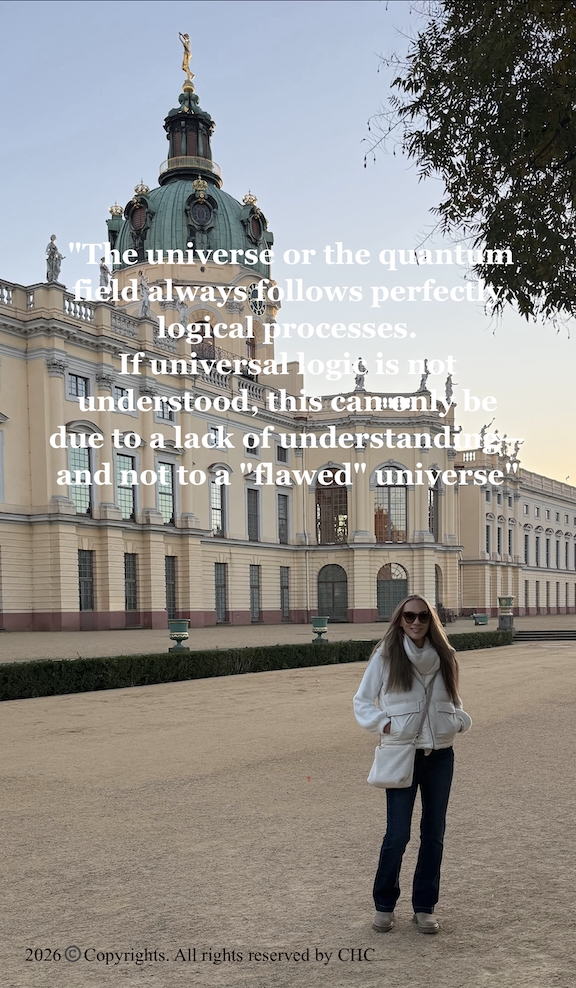
The quote is attributed to Clarissa Helene Constantinos, founder of the Syban Church, reflecting an esoteric philosophy that frames reality as an inherently orderly, conscious system.
While the statement employs terminology like the quantum field” to suggest cosmic logic, mainstream physics distinguishes between mathematically consistent subatomic laws and human intuition.
The statement reflects the esoteric philosophy of Clarissa, who argues that the universe operates on strict, inherent order rather than chaos. In her view, perceived flaws or randomness in reality stem from human perceptual limits rather than systemic errors in the cosmos.
This statement asserts that reality operates on a flawless, rational framework, and any perceived chaos or error is purely a result of human ignorance. It merges spiritual metaphysics with scientific terminology to argue for absolute cosmic determinism.
Philosophical Breakdown
Cosmic Determinism: The quote suggests that everything in existence adheres to strict rules of cause and effect. In this view, randomness, luck, and systemic flaws do not exist at a fundamental level.
Epistemological Humility: By attributing confusion to a “lack of understanding,” the statement shifts the burden of proof onto the observer. When events appear unfair, broken, or illogical, the quote implies our perspective is simply too narrow to grasp the underlying pattern.
Rational Spirituality: The philosophy mirrors ancient Stoic concepts like the Logos-the idea of a divine, rational force governing the cosmos. It treats the universe as a self-correcting, mathematically sound system rather than a chaotic accident.
The Use of “Quantum Field”
Bridging Science and Metaphysics: Invoking the “quantum field” gives a spiritual or philosophical idea a modern, scientific framing.
Scientific Contrast: While the quote uses quantum physics to imply absolute, predictable logic, mainstream quantum mechanics actually describes nature at a subatomic level as fundamentally probabilistic. In standard physics, quantum events are governed by statistical probabilities rather than strict, classical determinism.
This statement also reflects a classic deterministic and rationalist view of reality, closely aligned with Albert Einstein’s famous intuition that “God does not play dice with the universe.”
It suggests that apparent randomness or paradoxes in physics are merely gaps in human knowledge rather than features of nature itself.
Whether this view holds true is one of the deepest debates in modern physics and philosophy.
Arguments Supporting the Statement
Epistemic Limits: Throughout history, phenomena once seen as chaotic or supernatural (like lightning, planetary motion, or disease) were later explained by strict, logical physical laws.
Mathematical Consistency: Quantum field theory (QFT) is one of the most mathematically precise frameworks ever created. Even when particles behave strangely, their probabilities evolve according to exact, deterministic equations like the Schrödinger equation.
Hidden Variable Theories: Interpretations such as De Broglie–Bohm theory (pilot-wave theory) argue that quantum particles do follow completely logical, deterministic paths, guided by an underlying wave that we cannot directly observe.
Challenges from Modern Quantum Mechanics
Intrinsic Randomness: Under the standard Copenhagen interpretation, quantum events—like the exact moment a radioactive atom decays—are fundamentally probabilistic. There is no hidden “logical trigger” waiting to be discovered; the randomness is built into nature.
Bell’s Theorem: Experiments testing Bell’s theorem have largely ruled out local hidden variables. This means that if there is a hidden, perfectly logical mechanism governing quantum mechanics, it must violate locality (allowing instant influence across vast distances), which challenges classical ideas of cause and effect.
Human Logic vs. Universal Logic: Human “logic” evolved to help us survive in a macroscopic world of solid objects and linear time. Quantum mechanics may follow a completely consistent mathematical structure, even if it violates everyday human intuition.
Ultimately, the statement highlights a key philosophical divide: whether physics describes objective reality as it truly is, or simply what we are able to know about it.
This statement reflects a deeply rationalist and deterministic view of the cosmos, echoing the philosophies of thinkers like Spinoza and Albert Einstein. It suggests that nature operates on an infallible, underlying order, and any apparent chaos or paradox is simply a blind spot in human perception.
While this perspective is foundational to much of modern science, looking at it through the lenses of physics and philosophy reveals a fascinating debate over whether the universe is truly “logical” in a human sense, or if it operates on rules that break classical logic altogether.
1. Where Science Agrees: The Search for Underlying Order
Historically, this mindset has driven some of humanity’s greatest scientific breakthroughs.
Mathematics as the Language of Nature: From Newton’s laws of motion to Maxwell’s equations of electromagnetism, phenomena that once seemed chaotic or miraculous were eventually decoded into strict mathematical rules.
Einstein’s Realism: Albert Einstein famously held a view nearly identical to this quote. Uncomfortable with the probabilistic nature of early quantum mechanics, he argued that “God does not play dice with the universe,” believing that apparent randomness was merely the result of “hidden variables” humans had not yet discovered.
2. Where Quantum Mechanics Challenges the Premise
Modern quantum physics complicates the idea of a “perfectly logical” universe, depending on how we define “logic.”
Intrinsic Probability vs. Ignorance: Under the widely accepted Copenhagen interpretation of quantum mechanics, subatomic particles do not have definite properties until they are measured. According to Bell’s Theorem (and subsequent experiments), this randomness is not due to a lack of human knowledge or hidden variables. It appears to be an intrinsic feature of reality itself.
Quantum Logic: Classical human logic relies on binary rules, such as the Law of Non-Contradiction (a thing cannot both be and not be at the same time). Quantum phenomena like superposition (a particle existing in multiple states simultaneously) and entanglement violate classical intuition. Physicists actually had to develop a separate framework called “quantum logic” to describe how probabilities behave at the subatomic level.
3. The Philosophical Tension: Map vs. Territory
Epistemic Humility: The quote rightly points out human limitation. Our brains evolved to navigate a mid-sized, slow-moving world of rocks, predators, and weather—not the quantum realm or the curvature of spacetime. Calling the universe “flawed” because it confuses us is like blaming a foreign language for sounding like gibberish when we haven’t learned the vocabulary.
What Does “Flawed” Mean? Calling the universe “flawed” or “logical” projects human concepts onto an indifferent cosmos. The universe does not follow human rules of logic; rather, human logic is an imperfect tool we invented to model the consistent patterns we observe in the universe.
Summary
The quote captures the essence of scientific optimism: the belief that reality is consistent, lawful, and ultimately knowable. However, modern quantum physics suggests that while the universe follows strict mathematical rules, those rules may be fundamentally probabilistic and alien to what human beings traditionally call “logic.”
This quote comes from Clarissa, this statement bridges modern quantum terminology with esoteric spirituality and consciousness philosophy.
Context Within Syban Philosophy
Consciousness and Reality: Clarissa’s writings frequently explore the idea of “intentional reality-building” and aligning human consciousness with cosmic or universal laws.
Clarity Over Fear: A recurring theme in the Syban Church teachings is that confusion, fear, or perceived chaos stem from a lack of internal clarity or awareness, rather than an inherently broken or random universe.
Cosmic Order: By stating that the “quantum field always follows perfectly logical processes,” the quote frames the universe as an intelligent, orderly system. When events appear chaotic, unjust, or paradoxical to humans, Syban philosophy attributes it to human perceptual limits rather than a flaw in cosmic design.
How It Differs From Mainstream Physics
While the quote uses the term “quantum field,” it uses it in a metaphysical and spiritual sense rather than a strictly scientific one:
In Metaphysics / Spirituality: The “quantum field” is often used as a metaphor for a unified field of consciousness, energy, and divine logic that responds to awareness and intention.
In Physics: Quantum Field Theory (QFT) describes subatomic particles as excitations in underlying physical fields. While those fields obey strict mathematical rules, mainstream physics views individual quantum outcomes as fundamentally probabilistic rather than guided by a cosmic or spiritual logic.