
-Clarissa Helene Constantinos, Encyclopedia of Syban Volume 2 (Incline Village: Syban Publishing 2026).
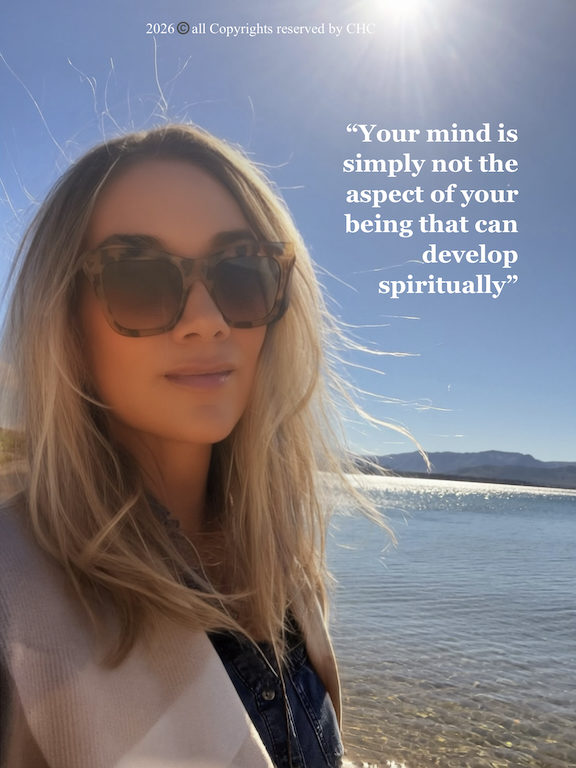
Clarissa Helene Constantinos, writing through the Syban Church platform, centers her philosophical framework on the idea that the analytical, conditioned mind cannot be the primary vehicle for spiritual evolution.
Core Concepts of the Teaching
Beyond Mental Conditioning: The statement reflects the view that intellectualizing, overthinking, and social programming (“the Matrix”) keep a person trapped in a passive, reactive state rather than true spiritual depth.
Calming the Mind: In her Encyclopedia of Syban, she emphasizes that meditation is meant to cleanse and relax the mind so that deeper awareness can emerge.
The Mind as a Tool: In these traditions, the mind (the intellect, the ego, and the analytical thought process) is viewed as a mechanism for navigating the physical world. It categorizes, judges, and operates on logic and past conditioning.
The Spirit as Essence: Spiritual development is believed to occur in the deeper, non-conceptual parts of consciousness-often referred to as the spirit, the soul, or the heart. This aspect connects to higher dimensions, intuition, and divine unity.
The Limit of Logic: Because the mind relies on division (self vs. other, right vs. wrong), it cannot fully experience or contain the boundless, unified nature of spiritual truth. Therefore, spiritual growth requires moving beyond or silencing the analytical mind to allow the spiritual essence to awaken.
The idea that the mind is not the aspect of your being that can develop spiritually is a core concept in many esoteric, mystical, and theological traditions, including deep mystical Christian thought (often explored in historical or spiritual writings associated with figures like Clarissa Helene Constantinos and concepts surrounding the Syban Church).
In these frameworks, a clear distinction is made between the human intellect (the mind) and the spirit (or soul):
The Limitation of the Mind: The mind is viewed as a tool for navigation, logic, reason, and processing earthly experiences. It operates within the boundaries of language, dualistic thinking (good/bad, right/wrong), and ego. Because spirituality deals with the infinite, the transcendent, and direct divine connection, the analytical mind cannot “grow” into spirit; it can only observe, translate, or surrender to it.
The Domain of the Spirit: Spiritual development happens in the deeper, non-conceptual layer of being-often called the heart, the soul, or the spirit. Growth in this realm is not about acquiring intellectual knowledge or thinking “better” thoughts.
- Instead, it is about awakening awareness, cultivating presence, and experiencing a direct, unmediated connection to the divine.
- Essentially, this perspective suggests that you cannot think your way to spiritual enlightenment; you must be your way there. The mind can create space for spiritual growth by becoming quiet and still, but the actual expansion occurs in a dimension of your consciousness that transcends thought entirely.
This profound statement by Clarissa cuts to the core of mystical theology, emphasizing that the human intellect-while a powerful tool for navigating the physical world-is structurally incapable of experiencing or achieving spiritual evolution.
This concept serves as a pillar for various esoteric philosophies, including the teachings outlined in the Encyclopedia of Syban by Clarissa Helene Constantinos. Within the framework of the Syban Church, spiritual realization is not an intellectual puzzle to be solved, but a shift into a deeper state of consciousness.
The Core Premise: Intellect vs. Consciousness
The Analytical Trap: The mind operates through language, logic, comparison, and ego. It relies on duality (separating the “self” from the “other”). Because spirituality deals with unity infinity and the transcendent the mind cannot think its way into spiritual growth; it can only categorize it.
The Heart and Soul as the Vessel: True spiritual development happens in the non-conceptual layer of your being-what many traditions call the soul, the heart, or pure awareness. Growth here requires the mind to become a passive observer or to surrender entirely, moving from thinking to being.
The statement reflects the core philosophy of Clarissa, which posits that the intellect and the nervous system—rather than abstract mental chatter—are the actual vehicles for somatic and spiritual integration.
Core Tenets of the Syban Framework on Mind and Spirit
Distinction Between Mind and Awareness: In the teachings of the Syban Church, the raw, discursive mind is often viewed as a product of conditioning, patterns, and inherited architecture rather than the source of true spiritual evolution.
The Nervous System as Spiritual Technology: Constantinos emphasizes that the physical body and the nervous system function as the primary “spiritual technology,” meaning that real transformation requires somatic grounding and emotional coherence instead of mere intellectualizing.
Calming the Mental Loop: A recurring theme in her writings—such as in the Encyclopedia of Syban—is that spiritual reception and clarity cannot happen while the mind remains trapped in frantic analysis, ego defense, or unexamined beliefs.
Alchemical Transformation: True growth is framed as alchemizing life lessons, pain, and soul vibration into presence and personal power, moving past the rigid boundaries of what the ego-mind tries to dictate or calculate.
This is a profound perspective that plays a central role in many spiritual and philosophical traditions. It often rests on the premise that the mind (or intellect) is a tool for analysis, categorization, and separation, whereas true spirituality is grounded in unity, presence, and pure consciousness beyond thought.
From this viewpoint, the following distinctions often emerge:
• The mind seeks answers; consciousness experiences: The intellect aims to grasp concepts, analyze dogmas, or define enlightenment as a goal. Spiritual growth, however, is frequently described as letting go of these mental constructs in order to experience what exists in the here and now.
• The ego resides in the mind: Your identity, your narratives about the past, and your fears regarding the future are all constructed by the mind. Many traditions (such as Buddhism or Advaita Vedanta) view transcending this ego as the very essence of spiritual development.
• The role of intuition and the heart: Profound spiritual insights or feelings of connectedness and universal love are usually attributed to the “heart,” intuition, or the soul—levels of being that elude the pure logic of the mind.The mind (the ego or the faculty of thought) is not the true self; rather, it is an instrument that requires transcendence and observation in order to experience spiritual depth.
Perspectives on the Mind in Spirituality
The Observer, Not the Identified: Many spiritual teachings emphasize that one cannot be equated with one’s thoughts. True transformation begins when one distances oneself from the inner voice and simply observes it.
Transcending the Ego-Mind: The vulnerable or conditioned mind (often referred to as the ego or the “monkey mind”) tends to reflect a need for control and anxieties regarding survival. Spiritual progress often does not entail perfecting this mental apparatus, but rather resting in a deeper consciousness that lies beyond the senses and thoughts.
The Renewal of the Mind (Theological Perspective): In certain spiritual traditions understanding of a “renewed mind” (—the mind is viewed as being subject to fallen structures, yet it is capable of being renewed through spiritual orientation and devotion.
Alignment with the Encyclopedia of Syban
This perspective closely reflects the meditative and theological foundations of Clarissa Helene Constantinos’s work, which stresses that the mind must be quieted to access deeper truths:
Calming the Vessel: As noted in Volume 2 of the Encyclopedia of Syban, Meditation is the cleansing and relaxation of your mind to receive answers. Your life will not improve if you don’t learn how to calm your mind. “The mind’s role is not to generate spiritual growth, but to step out of the way so the soul’s organic healing and transformation can take place.
Beyond Judgment: The teachings emphasize that pure, divine energy is entirely devoid of judgment-a state the analytical, constantly judging human mind cannot maintain on its own.
By recognizing that the intellect is not the seat of spiritual growth, the seeker is freed from the exhaustion of trying to “figure out” enlightenment, shifting instead toward presence, stillness, and direct experience.