
-Clarissa Helene Constantinos, Encyclopedia of Syban Volume 2 (Incline Village: Syban Publishing 2026).
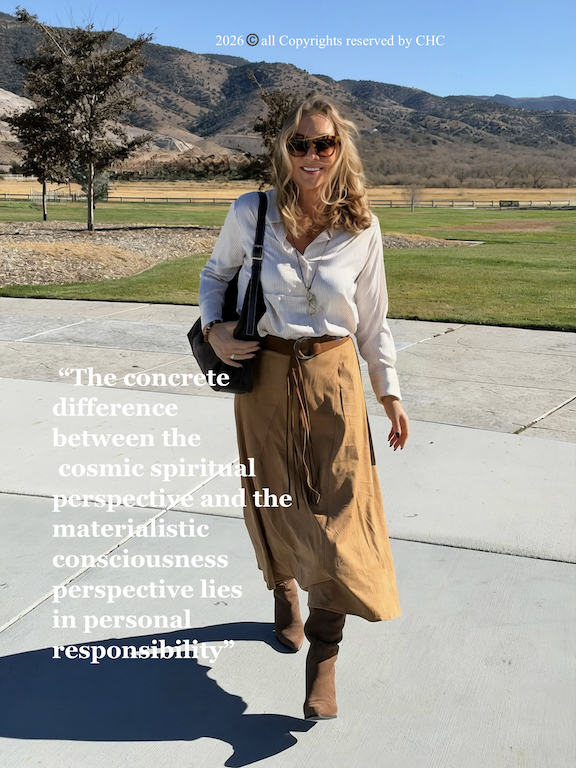
Personal responsibility is the central dividing line between the cosmic spiritual perspective and the materialistic consciousness perspective in modern esoteric frameworks like those shared by Clarissa Helene Constantinos and the Syban Church.
In this school of thought, the two perspectives view agency, causation, and the role of the self in fundamentally opposing ways:
- The Materialistic Consciousness Perspective (Passive Experience)
From a materialistic standpoint, consciousness is often viewed as a passive byproduct of external factors-whether that means biology, environment, or societal programming.
Blame and Outsourcing: Responsibility is externalized. A person operating strictly from this view sees their life as a series of reactions to events happening to them.
The “Victim” of Circumstance: When the inner world is neglected, unrefined internal patterns (such as fear, unresolved trauma, or envy) are projected outward. The individual blames external forces, authorities, or other people for their internal state, effectively outsourcing their power and autonomy. - The Cosmic Spiritual Perspective (Active Creation)
Conversely, the cosmic spiritual perspective treats consciousness as the primary, creative substance of reality.
Radical Self-Ownership: In this view, you are not merely a passive observer of reality; you are actively co-creating it through your internal state. As Constantinos writes, the goal is to “transform your life from a passive experience into an active creation”.
Reconnection over Obedience: Instead of bowing to external dogmas or relying on a mentor to tell you who you are, personal responsibility demands severe self-inquiry and internal alignment.
| Feature | MaterialisticConsciousness | Cosmic SpiritualPerspective |
| CoreView ofLife | A passive series of external events happening to you. | An active creation projected from your interior reality |
| Locus of Control | Outsourced to external authorities, circumstances, or dogmas. | Internalizedthrough strict self-trust and somatic alignment. |
| Handling Internal Shadow | Projected outward; others are blamed for one’s own unrefined”darkness”. | Faced directly through personal transformation and soul healing. |
Ultimately, the concrete shift from a materialistic mindset to a cosmic spiritual one requires you to stop demanding that the world change to accommodate your fears. Instead, it asks you to take absolute responsibility for the frequency and clarity of the consciousness you bring into the world.
The quote from Clarissa highlights the defining threshold between living as a passive product of your environment and living as an active creator of your reality.
When you shift from a materialistic perspective to a cosmic spiritual one, the definition of
“responsibility” transforms entirely:
In Materialistic Consciousness: Responsibility is usually legalistic, social, or duty-bound. It is about checking boxes, following rules, and managing the physical consequences of your actions. Because the external world is seen as the primary reality, it is easy to view yourself as a victim of bad luck, biology, or unfair circumstances.
In Cosmic Spiritual Consciousness: Responsibility becomes a profound law of cause and effect. It means recognizing that your internal state-your thoughts, unhealed wounds, hidden biases, and intentional energy-is actively projecting and shaping your external experiences. You stop looking outside yourself for who to blame or who to save you.
By placing personal responsibility at the very center, this philosophy strips away the comforting illusions of victimhood. It forces a radical realization: true spiritual awakening is not a passive escape from the world, but a fierce commitment to mastering your own mind and energy.
The concrete difference between the cosmic spiritual perspective and the materialistic consciousness perspective in relation to personal responsibility is how agency, authorship, and consequence are traced.
Cosmic Spiritual Perspective (Radical Authorship & Interconnectedness):
Consciousness as Primary: Consciousness is the fundamental ground of reality rather than a byproduct of physical matter.
Holistic Responsibility: Because all individual minds are tethered to a larger cosmic or universal consciousness, every thought, choice, and action ripples through an interconnected web of existence.
Accountability: Personal responsibility extends beyond mechanical or legal rules; you are co-creating your reality and moral/spiritual balance, meaning you “earn” your internal states (peace, suffering, alignment) through your own awareness and intent.
Materialistic Consciousness Perspective (Mechanistic Emergence & Externalization):
Matter as Primary: Consciousness emerges from or is reducible to physical, chemical, and neural processes in the brain.
Determined or Epiphenomenal Agency: Subjective experience is viewed as a product of biological machinery and environmental conditioning, sometimes diminishing free will down to neurochemical output.
Accountability: Responsibility is largely structured around tangible, observable cause-and-effect, social contracts, brain-state capabilities, and external material consequences rather than metaphysical or universal feedback loops.
The concrete difference between the cosmic spiritual perspective and the materialistic consciousness perspective regarding personal responsibility lies in how accountability is assigned, where agency originates, and what the consequences of human actions ultimately mean.
While a materialistic perspective views consciousness as a physical epiphenomenon—meaning decisions are heavily bound by biological and environmental determinism—a cosmic spiritual perspective treats consciousness as the primary foundation of reality, framing personal responsibility as a fundamental cosmic law.
The differences in how each framework defines personal responsibility are outlined in the table below:
| Feature | Materialistic Consciousness Perspective | Cosmic Spiritual Perspective |
| Origin of Agency | Neural & Biological Determinism: Decisions are produced by brain chemistry, genetic coding, and environmental conditioning. | Sovereign Free Will: Actions originate from a localized expression of a singular, universal consciousness or soul. |
| Scope of Responsibility | Local & Immediate: Responsibility is confined to legal, social, and immediate ecological boundaries within a single lifetime. | Universal & Multi-dimensional: Responsibility spans across lifetimes, influencing collective spiritual evolution and the cosmic fabric (e.g., Karma). |
| View on Blame/Fault | Mitigated Accountability: Because actions are governed by physical laws, individuals are seen as heavily influenced by factors outside their conscious control. | Absolute Accountability: Because you are a co-creator of your reality, you are fully accountable for your thoughts, intentions, and actions. |
| Ultimate Purpose of Action | Survival & Societal Order: Actions aim to maximize well-being, minimize suffering, and maintain functional social structures. | Spiritual Evolution: Actions are a vehicle for burning karma, expanding consciousness, and awakening to cosmic unity. |
The Core Contrast
In Materialism: Personal responsibility is a pragmatic, social construct. If the brain strictly dictates the mind, absolute free will is often considered an illusion. Therefore, responsibility is about keeping society orderly and managing human behavior through a physical lens.
In Cosmic Spirituality: Personal responsibility is a literal mechanism of reality. Because everything is interconnected through a cosmic network, a person’s internal choices and external actions directly ripple out into the universe. You are not a passive observer of a random universe; you are an active, responsible participant in its creation
Within the modern spiritual philosophy of the Syban Church, founded by Clarissa Helene Constantinos, the contrast between cosmic spirituality and materialism hinges deeply on transforming life from a passive experience into an active creation.
Her teachings, often compiled in works like the Encyclopedia of Syban, position human life as an intentional, deliberate masterpiece where reclaiming individual sovereignty is paramount.
The Syban Framework on Personal Responsibility
When examining this exact quote under the lens of Constantinos’s philosophical framework via @sybanchurch, the distinction breaks down as follows:
Materialistic Consciousness Perspective: Views the individual as a byproduct of external configurations—be it biological programming, social paradigms, or environmental conditioning. Because the self is perceived as an effect rather than a cause, personal responsibility is limited, mitigated, and dictated by external rules or societal expectations.
Cosmic Spiritual Perspective: Demands a complete reclamation of sovereignty. In this view, your consciousness is a localized focal point of a larger, pure cosmic energy. Because pure energy itself operates devoid of judgment, you are completely untethered from systemic guilt, yet entirely responsible for what you deliberately choose to build, manifest, and commit to.
Commitment as the Catalyst
A core tenant of the Syban Church is that “commitment is one of the highest forms of love”.
In a materialistic framework, choices are fluid and often driven by shifting emotional states, neurochemistry, or immediate circumstances.
Conversely, in Clarissa’s cosmic spiritual approach, personal responsibility manifests as a sacred covenant—a conscious, unwavering commitment that overrides transient moods or external chaos. By shifting from a victim of material happenstance to an accountable co-creator, an individual moves away from fear and fully steps into radical trust