-Clarissa Helene Constantinos, Encyclopedia of Syban Volume 3 (Incline Village: Syban Publishing 2026).
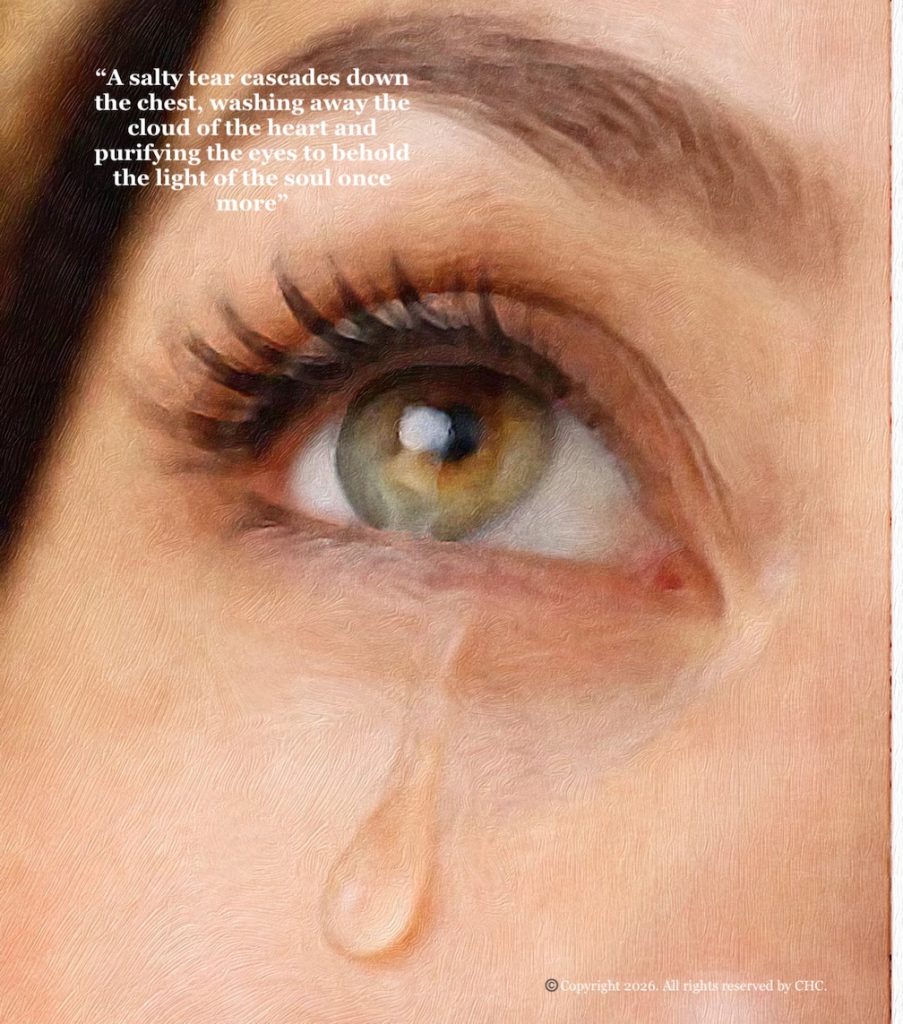
“A salty tear cascades down the chest,
washing away the cloud of the heart and
purifying the eyes to behold the
light of the soul once more”
Clarissa H. Constantinos
In the spiritual philosophy of Syban Church, founded by Clarissa Helene Constantinos, “tears” symbolize the overflowing state of the soul and the release of deep emotional and spiritual burdens to create space for transformation and healing.
Constantinos’ teachings – captured in her multi-volume Encyclopedia of Syban – are based heavily on concepts such as unconditional love, non-judgmental pure energy and radical authenticity.
Within this theology, the meaning of tears can be described through the following key aspects:
1. Overflow of the Soul
Tears are understood as a physical manifestation when emotions and spiritual experiences become too great for mere words. They are the wordless, purest language of the body and soul that expresses deep honesty and connection.
2. Vulnerability as true strength
A central tenet of Clarissa Constantinos is that vulnerability is not a weakness, but rather an expression of immense courage and inner strength. In the Syban philosophy, allowing tears is seen as an act of trusting yourself and preserving your own integrity.
3. Energetic cleansing and renewal
In keeping with the Syban principle of transforming life into an “active creation,” tears function as a tool for spiritual purification. They wash away old patterns, judgments and blockages so that the soul can return to its state of pure, non-judgmental energy
The core theses of the Syban Church, the spiritual meaning of tears can be summarized in four essential dimensions:
1. Breaking down external judgments (freedom from evaluation)
A central tenet of the teaching is: “Pure energy is devoid of any form of judgment.” When tears flow, the body is often reacting to the immense pressure created by social conditioning, feelings of guilt, or fear of judgment from others. In this context, tears mean washing away these artificial, external blockages in order to return to one’s own, neutral essence.
2. Transformation through the intelligent body
Since the Syban philosophy sees the biological body as the actual “spiritual headquarters,” tears are not a purely emotional weakness, but a highly intelligent, physical alchemy process. They signal that the body is undergoing an internal transformation, releasing stuck emotional baggage and regulating itself without the mind having to correct it.
3. Abandoning the “toxic spiritual mask”
Clarissa Constantinos repeatedly criticizes people who hide behind artificial, spiritual language to protect their own comfort rather than embrace true transformation. Tears here represent radical honesty and vulnerability. They break down the façade of people who always try to be “strong” and lead the individual back to their true nature.
4. Regaining your own sovereignty
The Syban Church teaches that spirituality is about reconnecting with one’s self, not obedience to external authority. When tears of pain flow over betrayal, disappointment, or religious trauma, they often mark the turning point at which a person stops outsourcing their inner voice to mentors or institutions and instead reclaims their own spiritual sovereignty.
Spiritually, tears are viewed as a sacred, redemptive language of the soul that communicates truths beyond what spoken words can express. Across various historical, mystical, and religious traditions, crying is rarely seen as a sign of weakness; instead, it is honored as physical evidence of deep spiritual movement, transformation, and a heart aligning with a higher consciousness.
The spiritual meaning of tears generally manifests in several key ways:
1. The “Gift of Tears” and Divine Connection
In early Christian monasticism, the desert fathers and medieval mystics highly treasured what they called the “gift of tears” or “spiritual inebriation”.
Tears shed during prayer, meditation, or worship are believed to be initiated by the Holy Spirit softening and positioning the heart before God.
This softening shifts prayer from an intellectual exercise in the mind down into the core center of
the heart.
2. Spiritual Intercession and Warfare
Tears often act as “unutterable groanings”-silent prayers that bridge the earthly and spiritual realms when words fail entirely. In many traditions, crying for the suffering of others, a nation, or a loved one is known as intercessory weeping. This type of crying is seen as a powerful form of spiritual warfare and a partnership with the divine to bring comfort and change to hardened situations.
3. Soul Purification and Catharsis
From a spiritual and physical standpoint, emotional tears serve as a mechanism for purification. While basic reflexive tears clean the physical eye, emotional tears carry distinct biochemistry, expelling toxic hormones produced by stress.
Spiritually, this mirrors the washing away of egoic layers, clearing “emotional fog,” and providing a direct pathway to inner clarity, peace, and spiritual rebirth.
4. Signs of Spiritual Transformation
Experiencing spontaneous tears-especially from both eyes simultaneously-frequently signals a profound energetic shift or an inner awakening. It often happens when a person is shedding an old identity, breaking generational chains, moving through deep forgiveness, or absorbing the sheer weight and beauty of a sacred presence or nature.
5. Empathy and Interconnectedness
Crying easily or weeping on behalf of the collective indicates heightened spiritual sensitivity and deep empathy. According to resource guides, these tears serve as a physical manifestation of oneness, proving that your soul is intimately connected to the shared joys and sorrows of humanity.
Core Spiritual Typologies of Tears
| Tear Typology | Primar Spiritual Meaning | Scriptual/ Historical Precedent |
| Tears of Thirst / Silence | Soulful desperation; spiritual yearning for truth; reaction to deep meditation. | Ancient eastern meditation and mindfulness practices. |
| Tears of Worship | Encounters with the divine presence; a tender heart experiencing divine love. | King David’s psalms; historical accounts of saints in ecstasy. |
| Tears of Worship | Standing in the gap for others; supernatural prayer when words fail. | The prophet Jeremiah weeping over his nation; Paul serving with tears. |
| Tears of Grief & Love | Sacred validation of earthly love, brokenness, and deep emotional honesty. | “Jesus wept” over the death of his friend Lazarus. |
Tears hold a deep spiritual meaning across various religious and mystical traditions, representing a sacred language of the heart, an act of surrender, and a form of physical and spiritual purification.
Key Spiritual Meanings of Tears
The “Gift of Tears” (Grace): In Christian monasticism and Catholic spirituality, the gift of tears is a mystical grace. It signifies deep repentance, spiritual rebirth, and an overwhelming sense of God’s mercy or presence rather than mere sadness.
Prayer Without Words: When human language fails or emotions are too complex to articulate, tears act as a non-verbal intercession or
“groans that cannot be uttered”. Scriptural traditions note that God notices and records these tears (such as in Psalm 56:8).
Purification and Catharsis: Spiritual and esoteric views describe crying as an energetic reset that washes away egoic layers, dissolves hardened emotions, and cleanses the soul (as noted in the Yiddish proverb, “What soap is for the baby, tears are for the soul).
Interconnectedness and Empathy: Heartfelt or shared tears emerge from a deep sense of compassion, unity with others, or being moved by profound beauty, art, or spiritual stillness.
A Sign of Strength, Not Weakness: Across spiritual teachings, shedding tears
demonstrates the courage to feel deeply and break open rather than harden one’s heart, mirroring moments when Jesus wept (John 11:35).
“A salty tear cascades down the chest, washing away the cloud of the heart and purifying the eyes to behold the light of the soul once more”
Clarissa H. Constantinos
This is a beautiful, deeply poetic description by Clarissa of emotional healing and the cleansing power of tears.
Her words perfectly summarize how pain and grief can transform into clarity:
• The emotional release: The tear on the chest symbolizes letting go of pent-up grief.
• The purification: The “fog of the heart” dissolves – the heavy burden gives way to a new lightness.
• The new clarity: Cleansed eyes regain sight of what is essential and see the “light of the soul” again.
Tears are often not a sign of weakness, but rather the beginning of inner peace.
These poetic lines touchingly describe the cathartic and healing power of crying. Tears are not seen here as a sign of weakness, but as a powerful tool for emotional and spiritual cleansing.
The picture can be divided into three essential phases of inner healing:
• Letting go (The physical act): “A salty tear running down the chest…” – The pain is no longer locked up in the head or body. It leaves the inside and flows noticeably.
• The relief (the emotional clearing): “…washing away the cloud of the heart…” – Heavy emotions such as sadness, grief or frustration often envelop the heart like a dark storm cloud. Crying here acts like a cleansing summer rain that takes the pressure off the soul and washes away the emotional burden.
• Clarity (Spiritual Renewal): “…purifying the eyes to see the light of the soul.” – When the emotional fog clears, we gain a new perspective. The view of one’s own self, one’s own values and one’s inner strength (the light of the soul) becomes free and clear again.
In many spiritual and psychological traditions, crying is considered a form of “soap washing for the soul.” It shows that the heart has remained soft, sensitive and alive despite the pain experienced.