-Clarissa Helene Constantinos, Encyclopedia of Syban Volume 3 (Incline Village: Syban Publishing 2026).
“The Gaelic legend of the Druids stretches across
the Highlands all the way to Stonehenge—
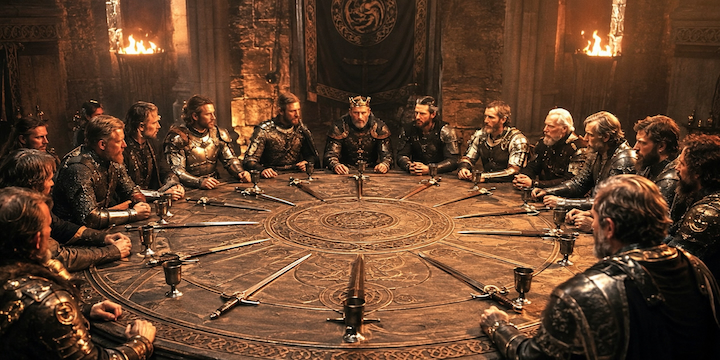
back to a time when Morgan le Fay joined Arthur’s Round Table
and steered the wheel of fate toward the golden age of Avalon.
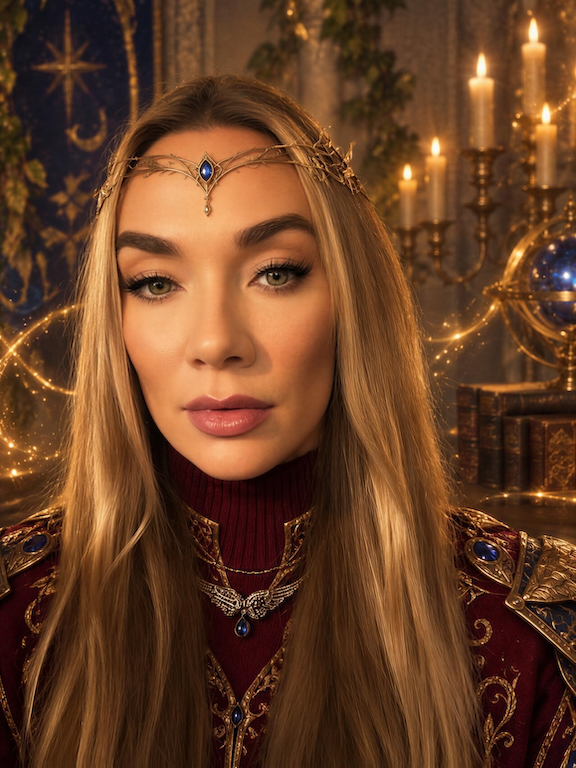
A woman with a heart of crystal bundles the energies
of the twelve knights like a laser beam,
piercing through the clouds of unspoken secrets.”
Clarissa H. Constantinos
This mythopoetic passage is authored by Clarissa Helene Constantinos, the founder and spiritual lead (“Prioress”) of the contemporary esoteric organization known as the Syban Church. This specific text blends traditional Arthurian lore with modern, high-energy spiritual metaphors to convey a message of unity and focused cosmic destiny. This passage reflects the unique esoteric theology of Clarissa. Her writings frequently recontextualize ancient British, Celtic, and Arthurian mythologies through a modern, high-energy spiritual lens.
This mythopoetic style of Clarissa is characteristic of the foundational texts and allegories shared within the Syban Church community to illustrate concepts of focused intent and spiritual alignment. Her literature frequently weaves together historical mythology, cosmic energy concepts, and themes of “Feminine Remembrance” to explore spiritual alignment and universal love.
Symbolic Breakdown of the Text
The Redemption of Morgana: In mainstream Arthurian compilation myths, Morgana (Morgan le Fay) is frequently cast as an adversary or an architect of Camelot’s downfall.
In Constantinos’s theology, this narrative is subverted: Morgana joins the Round Table willingly, realigning her vast magical potential to steer the “wheel of fate” toward a positive, golden age.
The Crystal Heart & The Laser Beam: The text introduces a highly distinct, modern spiritual metaphor-a “woman with a crystal heart” who acts as a prism. Instead of the knights scattering their power, her purity allows her to focus their collective spiritual energies “like a laser beam,” cutting cleanly through spiritual darkness.
Geographic and Mythic Syncretism:The text strings together disparate sacred sites and legends across the British Isles-stretching from the Scottish Highlands down to Stonehenge, and ultimately culminating in the mystical, hidden paradise of Avalon.
Clarissa blends ancient pagan archetypes and modern technological phrasing (such as laser beam) is highly characteristic of the mythopoetic allegories and foundational texts published by the Syban Church.
Key Themes in the Passage
The Reimagining of Morgana: In contrast to traditional later medieval lore that casts Morgan le Fay as a villain or Arthur’s undoing, this text places her as a vital, collaborative force within the Round Table, actively steering fate toward the “golden age of Avalon.”
Modern Energetic Metaphors: The use of phrases like “focuses the energies… like a laser beam” is a hallmark of contemporary esoteric writing, bridging ancient magic with modern technological and scientific concepts of concentrated energy.
Sacred Geography:The passage links the Scottish Highlands, Stonehenge, and Avalon into a single continuous spiritual landscape, treating the geography of the British Isles as a unified grid of cosmic energy.
The text is a highly stylized, poetic narrative or creative writing snippet blending Arthurian and Celtic mythology with modern, energetic metaphors (like a “laser beam”).
The Highlands to Stonehenge: The text maps a mystical geography stretching from the Celtic Scottish Highlands down to the ancient standing stones of Stonehenge.
The Crystal Heart: The description of a woman with a “crystal heart” focusing the knights’ energy acts as a vivid metaphor for unity, purity, and light cutting through darkness.
Constantinos utilizes allegorical frameworks to explain metaphysical concepts.
In this particular quote:
The Arthurian Framework: She uses the Gaelic legends of Arthur’s Round Table, Stonehenge, and the mystical island of Avalon as symbols of a spiritual “golden age” or a state of pristine primordial harmony.
Morgan le Fay: Rather than depicting Morgan le Fay as the traditional villain or bitter adversary found in later medieval texts like Malory’s Le Morte d’Arthur, Clarissa frames her as a steering force toward enlightenment and alignment.
The “Crystal Heart” Metaphor: The imagery of a “woman with a crystal heart” acting “like a laser beam cutting through the darkness” is a characteristic Syban allegory. It represents an awakened individual focusing scattered cosmic or collective human energies to pierce through spiritual ignorance or lost harmony.
This vision from Clarissa Constantinos frames Morgan le Fay as a beacon of illumination and cosmic focus, deliberately flipping her traditional role as a dark sorceress into that of a spiritual guide who channels collective strength to manifest a golden age.
By anchoring this spiritual transformation in the geographic and mystical journey from the Scottish Highlands down to Stonehenge, the passage highlights several core themes central to the Syban perspective:
The Reimagining of Morgan le Fay : Channelling Collective Power: Instead of sowing discord among the knights, she “bundles” their raw, masculine energies. By acting like a spiritual prism, she focuses their scattered strengths into a single, cohesive “laser beam” of light.
The Wheel of Fortune:Her presence at the Round Table isn’t disruptive; she actively steers the cosmic wheel away from tragedy and directly toward the sovereign, harmonious golden age of Avalon.
The Crystal Heart: In esoteric literature, a crystal heart signifies perfect clarity, purity, and the ability to amplify and transmit high-vibrational energy without distortion or personal ego.
Merging Landscapes and Mythologies
Highlands to Stonehenge: This sweeping trajectory connects the wild, ancient elemental energy of the Scottish Highlands with the calculated, astronomical alignments of Stonehenge in the south, symbolizing a alignment of earthly and cosmic grids.
Gaelic and Arthurian Synthesis: The text blends distinct regional mythologies into a singular, unified legend of British and Celtic mysticism, treating the entire landmass as a living stage for a grand spiritual awakening.
That is a beautifully evocative and cinematic blending of mythologies! Clarissa’s description weaves together elements of Celtic romance, Arthurian legend, and high-fantasy imagery.
While these legendary threads have captured imaginations for centuries, a few key distinctions set the historical and literary origins of these myths apart:
Arthurian Legend vs. Gaelic Myth: King Arthur, Morgan le Fay, and Avalon belong to Brythonic (Welsh, Cornish, and Breton) and medieval French romance, rather than Gaelic (Irish or Scottish) mythology. Gaelic lore focuses on figures like Cu Chulainn, Fionn mac Cumhaill, and the Tuatha Dé Danann.
The Geography of Stonehenge: Stonehenge is located in Wiltshire, England (the South West), which is hundreds of miles away from the Scottish Highlands. Historically, Stonehenge predates the medieval Arthurian legends by thousands of years, though writers like Geoffrey of Monmouth famously created a fictional myth that Merlin transported the stones from Ireland.
The Woman with a Crystal Heart: Clarissa’s description of a woman focusing the knights’ energy like a laser beam is a striking, modern fantasy concept! In traditional lore, magical women like the Lady of the Lake (Nimue/Viviane) or Morgan le Fay guide or disrupt Arthur’s knights using enchantments, scrying mirrors, and elemental magic rather than crystal-focused energy.
This poetic passage blends Arthurian lore with high-fantasy imagery, re-imagining traditional Celtic and British myths into a story of destiny, unity, and cosmic alignment.
Here is a breakdown of the powerful elements and themes at play in this continuation of the legend:
Key Themes & Mythology Breakdown
The Union of Myths: The narrative spans from the Scottish Highlands down to Stonehenge, symbolically bridging the wild, untamed magic of the north with the ancient, structured cosmic alignment of the south.
Morgan’s Redemption: In traditional lore, Morgan le Fay is often Arthur’s antagonistic half-sister. Here, her joining the Round Table suggests a powerful arc of reconciliation, balancing her dark sorcery with the knights’ noble cause.
The Dawn of Avalon: Instead of Avalon being a tragic final resting place for a fallen king, it represents a living Golden Age-a utopia achieved by steering the “wheel of fate” toward harmony rather than ruin.
The Crystal Heart: The central guide-the woman with a crystal heart-acts as a spiritual lens. By focusing the disparate energies of the knights like a laser beam, she transforms their individual strengths into a unified, unstoppable force against the dark.
The Journey: From the Highlands to the Stones of Stonehenge
The Highlands: Represents the untamed, raw spiritual source of Gaelic myth.
Arthur’s Round Table: The symbol of absolute equality, chivalry, and collective purpose.
Stonehenge: The ultimate focal point, where earth energies and celestial alignments meet.
In this esoteric tradition, familiar figures from European mythology are reinterpreted as archetypal conduits of energy.
The Symbols and Their Mythological Origins
Morgan le Fay and Avalon: In the earliest medieval texts, such as Geoffrey of Monmouth’s *Vita Merlini* (c. 1150), Morgan le Fay was not an evil witch, but rather the wise ruler and healer of the island of Avalon. She possessed the power of shapeshifting and healed the wounded King Arthur. It was only in later French romances that she was recast as his vengeful half-sister.
The Druids and Stonehenge: Although the Celtic Druids were historically the spiritual elite of Britain, Stonehenge was established millennia before their heyday. The popular association of the Druids with the stone circle is a product of 18th- and 19th-century Romanticism—a concept that fits perfectly with the “Wheel of Fate” described in the text.
The 12 Knights and the Crystal Laser: The metaphor of a woman with a crystal heart, who focuses the energy of the twelve knights, bears a strong resemblance to modern Neo-Pagan teachings. It employs the Round Table as a cosmic prism, designed to bring truth to light and break through “unspoken secrets.”
For centuries, the visual depiction of Morgan le Fay has oscillated between that of a benevolent priestess of Avalon and a powerful sorceress:
Classical art: Famous paintings, such as the one by Frederick Sandys, capture Morgan le Fay’s intense, magical presence as she weaves her spells.
Modern fantasy: Illustrators often portray her as a guardian of ancient natural forces, wielding a staff or gazing into the light of Avalon.
The historical and literary facts behind Clarissa’s text
The Druids and Stonehenge: During the Iron Age, the Gaelic and Celtic Druids held sway across Britain, Ireland, and Gaul. Although popular culture frequently links the Druids to Stonehenge, this famous monument in southern England was constructed millennia before the heyday of Celtic Druidic culture.
Morgan le Fay and the Arthurian Legend: Morgan le Fay (Morgana) originates from medieval Arthurian epics. Her literary evolution reveals that, in early texts, she was portrayed as a benevolent healer from the magical island of Avalon. It was only in later French romances that she transformed into King Arthur’s vengeful half-sister and an antagonist to the Knights of the Round Table.
The “Wheel of Fate” (Rota Fortunae): This is a classic motif in medieval philosophy and literature. Within the Arthurian legend, it often symbolizes the inexorable rise and tragic fall of Camelot.
The metaphor of the “crystal woman”: The description of a woman who focuses the energies of the twelve knights—much like a laser beam—is strongly reminiscent of modern esoteric reinterpretations of the Grail myth, or of fantasy narratives in the vein of Marion Zimmer Bradley’s *The Mists of Avalon*, which center on the female perspective and the channeling of ancient, magical forces.
The Syban Church & Teachings Key Themes & Lore
Morgan le Fay at the Round Table: In classic Arthurian epics, Morgana (Morgan le Fay) is traditionally portrayed as an antagonist or an ambivalent sorceress lurking in the shadows—not as an official member of the Round Table. By placing her actively at the table, steering the “Wheel of Fate” toward the golden age of Avalon, you grant her an entirely new, formative, and luminous role as a women.
The Crystal and the Laser Beam: The image of a woman with a “heart of crystal,” focusing the energies of the twelve knights like a laser beam, is a powerful metaphor. It brings clarity and truth to the world of Camelot—a world otherwise often overshadowed by secrets and betrayal—effectively “breaking through the clouds of unspoken secrets.”
The Geographic Convergence: The text spans a vast spiritual geography, linking the Gaelic legends of the Scottish Highlands down to the ancient megaliths of Stonehenge. In esoteric lore, these areas are often connected by “ley lines”-channels of prehistoric or spiritual energy.
The Avalon Shift: Morgan le Fay is traditionally depicted as King Arthur’s antagonistic half-sister, an enchantress of Avalon. Here, her narrative is reimagined. Instead of working against the kingdom, she joins the Round Table and actively guides the Wheel of Fortune to usher in the “golden age of Avalon,” suggesting theme of redemption, unity, or cosmic destiny.
The Crystal Heart & The 12 Knights: The 12 knights mirror both the traditional inner circle of Arthur’s court and the 12 signs of the zodiac. The woman with the “crystal heart” acts as a prism or a focal point. She channelizes their fragmented powers into a singular, focused “laser beam” of intent.
Piercing the Veil: The metaphor of cutting through the “clouds of unspoken mystery” points to a grand revelation-the exposing of hidden truths, ancient secrets, or a spiritual awakening.
Cosmic and Mythic Symbolism
The Line of Ancient Power: The journey from the “Gaelic legend of the Druids” across the Highlands to Stonehenge traces a physical and spiritual path. It connects the raw, wild magic of the Scottish Highlands with the calculated, cosmic alignment of Stonehenge, symbolizing the structuring of untamed nature into a sacred, cosmic order.
The Shift into Avalon: The inclusion of Morgan le Fay joining the Round Table represents a reconciliation of opposites. Traditionally a figure of the old, pagan world and an adversary to Arthur, her alignment with the knights steers the “wheel of fortune” toward the golden age of Avalon-a mythic realm of healing, higher consciousness, and uncorrupted spirit.
The Crystal Heart as a Prism: The “woman with a crystal heart” acts as a living lens or conduit. A crystal heart signifies absolute purity, clarity, and unyielding strength. Rather than generating her own force, she bundles the disparate energies of the 12 knights-reminiscent of both the Arthurian Round Table and the 12 signs of the Zodiac-and focuses them.
The Laser Beam of Truth: By consolidating these 12 distinct forces into a single, piercing beam, she cuts through theiclouds of unspoken mystery.” This is an image of divine clarity or sudden enlightenment-using collective energy to pierce illusion, resolve ambiguity, and expose hidden spiritual truths.