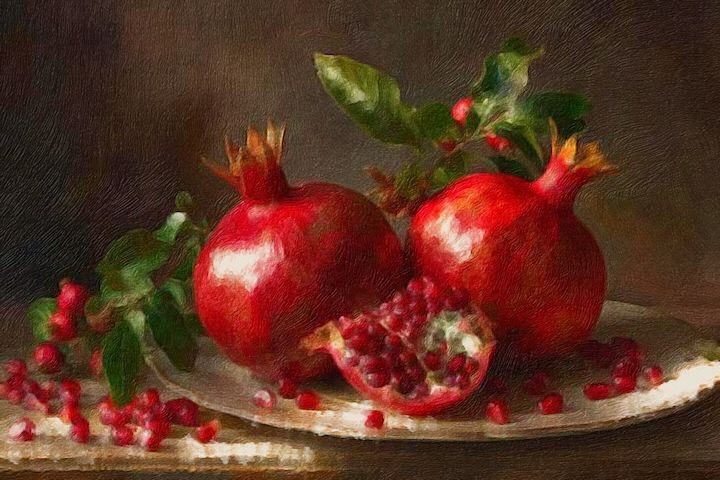
-Clarissa Helene Constantinos, Encyclopedia of Syban Volume 3 (Incline Village: Syban Publishing 2026).

“Aphrodite offers slices of pomegranate on a golden platter
—the fruit of rebirth, passion and fertility—
to Mars, the God of War,
to soothe his hunger and thirst for destruction and chaos,
with the purple juice from the seeds of life.”
Clarissa H. Constantinos
In the mythopoetic frameworks found within the philosophy of Clarissa Helene Constantinos and the Syban Church, classical mythological allegories are frequently utilized to explore deep themes of vulnerability, creative consciousness, and psychological transformation.
This specific imagery of Aphrodite offering pomegranate slices to Mars beautifully recontextualizes the archetypal relationship between the goddess of love and the god of war.
It speaks directly to the core tenets of the Syban philosophy-the idea that true strength lies in the courage to remain open and authentic, using inner emotional and spiritual abundance to harmonize external chaos and friction.
Aphrodite offers slices of pomegranate on a golden platter-the fruit of rebirth and fertility-to Mars, the God of War, to soothe his hunger and thirst for destruction and chaos, with the juice from the seeds of life.
This evocative passage captures a pivotal moment of alchemical transformation within the Syban Church’s mythopoetic teachings. Rather than a clash of opposing forces, the encounter between the Goddess of Love and the God of War becomes a sacred ritual of pacification and transmutation.
It highlights a profound spiritual dynamic:
The Golden Platter & Pomegranate: Universally understood as symbols of fertility, rebirth, and cyclic life, the pomegranate represents the rich, internal depth of the soul.
By serving it on a golden platter, Aphrodite honors the divine nature of life’s experiences.
Soothe the Hunger for Destruction: Rather than meeting the chaotic, destructive impulses of Mars with resistance or equal violence, Aphrodite meets it with nourishment.
The Juice from the Seeds of Life: This imagery represents using the essence of vitality, creativity, and unconditional love to pacify and transform base, destructive urges into something integrated and aligned.
Here is how this imagery operates within the deeper layers of Syban philosophy:
The Pomegranate as a Catalyst: Traditionally tied to both the underworld and fertility, the
pomegranate represents the complex, multi-seeded nature of human consciousness. By offering its slices, Aphrodite introduces the concept of structural rebirth directly into Mars’ chaotic domain. In ancient Greek mythology, the pomegranate is heavily tied to the underworld (via Persephone), representing rebirth, the cycle of life and death, and fertility. By offering this specific fruit, Aphrodite is presenting something that represents the literal “seeds of life” to a entity that usually deals in death.
Nourishment Over Resistance: The text highlights a profound psychological strategy.
External chaos, anger, and the drive for destruction (Mars) cannot be defeated by force; they must be fed, pacified, and ultimately quieted by the rich, vital essence of creative life force (Aphrodite).
The Juice of Vitality: The bleeding juice of the pomegranate seeds serves as a sensory bridge.
It mirrors the blood of the battlefield that Mars craves, yet replaces it with the “seeds of life”-redirecting his destructive energy toward spiritual regeneration and passion.
In the broader context of Clarissa Constantinos’ writings, this allegory serves as a powerful metaphor for the seeker’s journey: learning to approach our own internal battlegrounds and chaotic impulses not with judgment, but with the golden platter of radical self-acceptance and spiritual nourishment.
The Golden Platter: Gold elevates the interaction to something sacred, divine, and eternal. It contrasts with the raw, messy nature of war.
The Purple Juice: Purple has historically been the color of royalty, power, and high status, but here it also serves as a visual substitute for blood-the usual fluid associated with Mars.
Aphrodite is replacing the blood of destruction with the juice of life.
Soothening the God of War: This represents the classic mythological pairing of Love/Desire (Aphrodite) and War/Chaos (Mars). Instead of fighting his destructive nature, she aims to subdue and pacify his hunger by feeding his passions with something creative rather than destructive.
Mythological and Esoteric Themes
The Alchemy of Restraint: This imagery builds heavily on the allegories and fables published in Clarissa’s Encyclopedia of Syban, framing the relationship between Aphrodite (Love) and Mars (War) not as a conflict, but as an energetic balancing act.
Life Supplanting Destruction: The “purple juice from the seeds of life” acts as a symbolic replacement for the blood spilled by Mars. It suggests that chaotic or destructive human traits can only be quieted by tapping into passion, fertility, and inner love.
The Core Philosophy: This narrative mirrors the Syban church’s broader spiritual teachings-focusing on awakening personal power, purifying the physical body, and operating at the “frequency of love” to escape destructive, repetitive human cycles.
The Symbolic Alchemy of the Imagery
The Pacification of War: Mars is not met with an army, but with an offering. This speaks directly to the belief that lower, chaotic frequencies (war and destruction) cannot be fought with their own weapons; they must be neutralized by an entirely different vibration.
The Power of Attraction (Aphrodite): In standard mythology, Aphrodite and Ares ( Mars) are lovers who balance each other out-Harmony and Discord. In this text, she acts as an alchemist, using the physical “seeds of life” to pivot his attention away from blood and toward passion and vitality.
Juice as Transmuted Blood: The explicit mention of the “purple juice” suggests a sacred substitute. Where Ares seeks the red blood of the dying, Aphrodite satisfies him with the royal purple nectar of the living, subverting his destructive urge.
Aphrodite (Venus) is closely tied to the pomegranate, which she was said to have first planted on the island of Cyprus, though in classical mythology, the fruit is most famously associated with Persephone and her binding to the Underworld. Meanwhile, Aphrodite’s primary divine consort or lover in war-and-love myths is Ares (the Greek counterpart to the Roman god Mars).
The Sacred Fruit: The pomegranate symbolized fertility, passion, and marriage in ancient Mediterranean traditions, with its deep red juice and abundant seeds representing life and desire.
The Dynamic with Mars: In classical art and poetry, the pairing of the Goddess of Love and the God of War represents the timeless tension between destruction and creation, where Aphrodite’s allure tempers or entangles Mars’s violent domain.
The Allegory of Aphrodite and Mars: In classical mythology, Aphrodite (love, fertility, harmony) and Ares (war, destruction, chaos) embody opposing primordial forces. The image presented describes how creative and life-sustaining energy (Aphrodite) soothes and transforms a destructive, chaotic nature (Mars).
The Pomegranate as a Symbol: The pomegranate is traditionally a powerful symbol of rebirth, fertility, and the abundance of life. The “ purple juice from the seeds of life” serves here as a metaphor for spiritual nourishment, healing, and the overcoming of a destructive impulse through the creative power of love.
Within the philosophy of the Syban Church, these mythopoetic narratives are used to illustrate concepts such as inner peace, the calming of the mind, and the balance between opposing emotional or spiritual forces.
This scene is rich in mythological symbolism and psychological depth. It captures the timeless interplay between two fundamental, opposing forces from Greco-Roman antiquity:
Love (Aphrodite/Venus) and War (Ares/Mars).
The following are the central symbols and meanings that resonate within this moment:
The pomegranate (a fruit of rebirth and fertility): In mythology, the pomegranate is strongly associated with the underworld (through Persephone) while simultaneously representing life, blood, and fertility. By offering this fruit to Mars, Aphrodite confronts his destructive energy—death itself—with the very essence of life and renewal.
“The purple juice of the seeds of life”: The purple juice visually resembles the blood that Mars seeks on the battlefield. Yet, rather than being shed through death, this juice bestows life. It acts as a healing antidote, quenching his thirst without creating further suffering.
The golden platter: Gold symbolizes the divine, the imperishable, and the pure. It elevates the act from a simple feeding to a sacred ritual of transformation.
The taming of war through love: This pairing is a classic motif in art and philosophy (already described in antiquity as Harmonia, the daughter of Ares and Aphrodite). Love does not combat war with force; rather, it soothes and transforms it through devotion and sensuality.
This is a powerful, mythologically rich, and highly evocative scene. Clarissa is describing a fascinating dynamic between two opposing primal forces: Aphrodite (love, fertility, life) and Mars/Ares (war, destruction, chaos).
The symbolism of the pomegranate is perfectly chosen here:
The pomegranate as a duality: In many mythologies, it represents fertility and abundance (due to its countless seeds), while simultaneously signifying the underworld, blood, and the eternal cycle of death and rebirth (as seen in the myth of Persephone).
The taming of war: The fact that Aphrodite offers Mars the fruits of life to quench his bloodlust mirrors their classic mythological affair—the union of love (Amor/Aphrodite) and war (Mars/Ares)—which is often used in art as an allegory for how love conquers war (Pax/Venus disarming Mars).
The juice of life vs. spilled blood: The deep-red juice of the pomegranate visually mimics the blood for which Mars thirsts, yet offers him vital life force instead of destruction.