
Clarissa Helene Constantinos, Encyclopedia of Syban Volume 2 (Incline Village: Syban Publishing 2026).
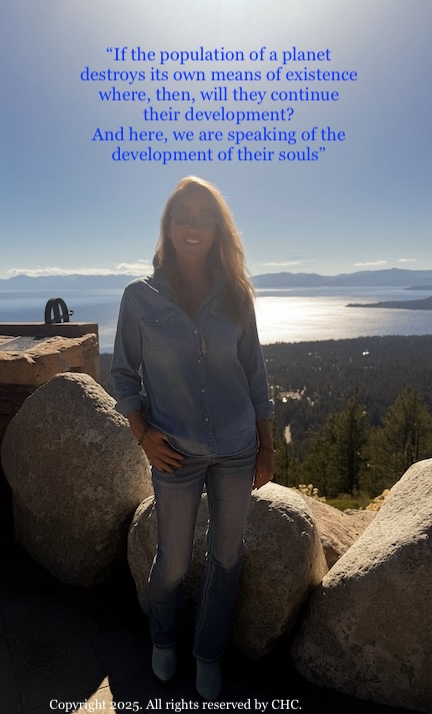
Clarissa ask a profound, philosophical, and spiritual question. From the perspective of most reincarnation theories, Theosophy, and metaphysical teachings, the answer is clear: souls continue their evolution on another planet or plane of existence that corresponds to their level of consciousness. When a civilization ruins its own home planet, the souls do not stop growing. They move to other worlds or spiritual planes that match their current level of evolution so they can keep learning their lessons.
In many spiritual and esoteric traditions like in Clarissa’s teachings, the universe acts as a massive school system. If one classroom gets shut down, the students are simply transferred to a new one.
When a civilization destroys its physical home, the evolution of the soul does not end however,
here are the essential levels describing this process in spiritual teachings:
Reincarnation on other physical worlds: In metaphysics, the universe is viewed as infinite and teeming with life. When a planet becomes uninhabitable, souls are drawn by the cosmic law of resonance (or karma):
Suitable conditions: They incarnate on planets at a similar stage of development to relearn unresolved lessons (such as harmony, environmental stewardship, or collective survival).
Fresh start: This is often experienced as an evolutionary step backward on the physical plane—souls may have to start over in more primitive conditions due to the lack of technological infrastructure.
Sojourn in subtle intermediate realms: Before incarnating physically again, souls remain in subtle dimensions (often called the astral or spirit world).
Processing: In these realms, souls reflect on their experiences and the collective failure.
Healing: Souls traumatized by the catastrophic end of a world undergo phases of rest and healing before they are ready for new tasks.
Collective karma and the cosmic school: In many schools of thought confirm the teachings of Clarissa, that a planet is considered a kind of “classroom.” If the class destroys the classroom, learning does not cease—the students are simply reassigned.
Responsibility: Destroying the foundation of one’s own existence generates powerful collective karma. In future lives, souls must learn how to preserve creation rather than destroy it.
In summary: The death of a planet marks the end of a physical stage, but the soul is indestructible and moves on to where cosmic learning can continue.
Where Do They Go?
New Physical Planets: Souls often incarnate—meaning they are born into a new physical body—on a different planet that is at a similar or slightly more forgiving stage of development.
Spiritual Realms (Between Lives): Before they are reborn somewhere else, souls spend time in a non-physical, transitional dimension. Here, they process the collapse of their world, rest, and review what went wrong with their spiritual guides.
Higher Dimensions: If a group of souls learned a massive, painful lesson through the destruction of their planet, some might shift to a higher, non-physical frequency of existence if their collective consciousness matured through the crisis.
The Process of Transition
The Cosmic School: Planets are viewed as living classrooms. When a planet can no longer sustain life, it closes its doors as a school for physical incarnation.
Resonance of Vibrations: Souls are naturally drawn to a new environment that corresponds to their inner state (their “vibration” or level of maturity). They do not go to a place far beyond their capabilities; instead, they choose an environment where they can continue to face challenges and grow.
Wanderers and Seed: According to some traditions, Earth has frequently welcomed souls from other worlds—worlds that were either doomed or in crisis—thereby serving as a melting pot for a vast array of cosmic experiences. Clarissa’s writings also compellingly demonstrate that souls from highly evolved planets visit other worlds to “support” the development of younger civilizations or to assume a teaching role in order to establish profound knowledge.
Philosophical meaning of the Quote
The quote is a core premise of Clarissa and the teachings of the Syban Church.
This specific philosophy reframes environmental responsibility from a material obligation into an absolute spiritual necessity. In this view, a planet is not merely a resource or a physical home, but a metaphysical classroom designed specifically for the refinement, testing, and evolution of human souls. The quote addresses a central theme in esoteric philosophy, reincarnation, and spiritual evolution.
According to this doctrine:
The Cosmic Sandbox: If humanity destroys its own biosphere, it doesn’t just commit physical suicide; it effectively “shuts down the school,” leaving souls without the necessary material vehicle and environment required to progress to higher spiritual dimensions.
The Game of Souls: Clarissa frequently describes life as an active creation-or the
“game of souls”-where maintaining the physical vessel (the planet) is tied directly to the continuity of spiritual development.
The core philosophical problem posed by this question can be explored through a few distinct spiritual lenses:
The Interplanetary Reincarnation Model
In many esoteric frameworks (such as Theosophy, Spiritism, and various New Age philosophies), the universe contains countless planes and planets designed as “school” for the soul.
Shift to Non-Physical Densities or Realms
Another common spiritual interpretation is that physical planets are only temporary staging grounds.
- If the physical container (the planet) is ruined, souls return to the astral, etheric, or spiritual realms indefinitely.
- In these higher dimensions or “densities,” they undergo intense periods of life review and collective healing.
- Without a physical backdrop to act out their karma, their development continues internally or through non-physical creation until a suitable physical environment becomes available.
Cosmic Quarantine and Karmic Loops
From a stricter karmic perspective, destroying one’s own means of existence creates a massive collective debt.
- The development of these souls might stall in a state of spiritual quarantine.
- They may have to experience the psychological and spiritual weight of the destruction they caused.
- Their subsequent development often involves re-living the cycle on a parallel timeline or waiting for the planet to slowly regenerate over millennia so they can reincarnate on a barren world and help rebuild it from scratch.
Ultimately, the quote highlights the idea that while humanity can destroy its physical infrastructure, the soul is indestructible. The universe will always provide a new matrix for growth-even if that means repeating a painful cosmic grade until the lesson of planetary survival is finally learned.
Key Themes Explored
Planets as Spiritual Incubators: The physical world serves a higher metaphysical purpose-it is a training ground for the soul’s development.
The consequences of self-destruction: When a civilization exhausts its resources or destroys its home world, it essentially “shatters” its spiritual place of learning, thereby raising a profound cosmic question: Where does a displaced collective consciousness go to finish its education?
Active Creation vs. Passivity: Clarissa’s broader teachings emphasize shifting from being a passive bystander to an active creator of your reality, encouraging humanity to treat life with a higher level of respect and spiritual responsibility.
Nevertheless, it leaves a mark on the divine blueprint when a planet is destroyed by its own inhabitants—whether through negligence or out of greed for its resources. The planet becomes a graveyard, a monument to misguided intentions ( Planet Mars). The planet itself possesses a soul; it is connected to its inhabitants across many multidimensional planes and is part of the evolutionary process of each individual soul. (Legend of the Red Planet)