-Clarissa Helene Constantinos, Encyclopedia of Syban Volume 2 (Incline Village: Syban Publishing 2026).
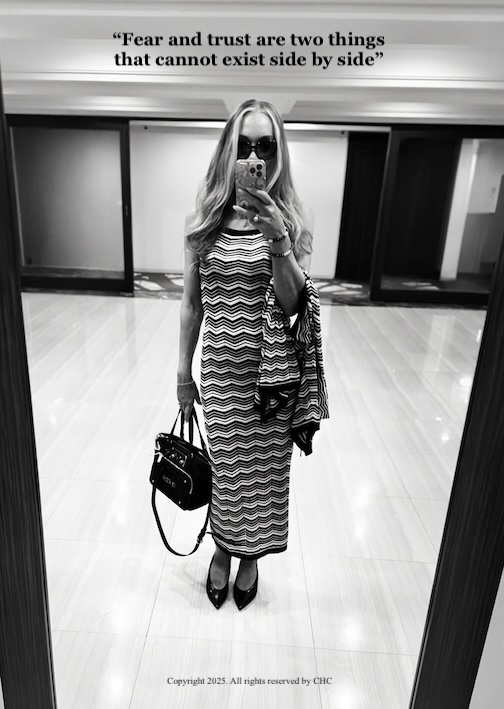
The quote from Clarissa “Fear and trust are two things that cannot exist side by side” originates from the philosophy and platform of Clarissa, shared through her spiritual or philosophical work known as Syban Church.
This teaching focuses on the psychological and spiritual incompatibility of fear and trust, suggesting that true trust requires the complete surrender and absence of fear.
Its a powerful psychological and spiritual truth: fear and trust are mutually exclusive emotional states.
Core Philosophy
In this spiritual and philosophical framework, fear and trust are viewed as diametrically opposed forces. The teachings suggest that:
When you choose to fully trust-whether in yourself, another person, or a higher path-you let go of the need to control the outcome, which naturally dissolves fear. Conversely, when fear takes over, it signals a lack of trust in your ability to handle what comes next.
Trust in yourself is the key. No matter what life challenges are, your trust in yourself to be able to handle the situations is the confidence in your own abilities. If you give someone your trust and this person mishandles this gift, it has nothing to do with you, or your generosity of giving your trust. If your trust was misused by another person, you have to know what you need to do as the consequence of this behavior. You have to trust yourself to take the necessary steps to balance things out and learn your own lesson in this situation.
Within the metaphysical framework of Clarissa and her teachings, this quote highlights why so many people remain trapped in cycles of control and limitation.
The Illusion of Fear vs. True Trust
The Ego’s Strategy: The ego uses fear as a tool to try and guarantee safety. It convinces you that if you worry enough about poverty, loss, or injury, you can prevent them.
The Toll on Trust:This constant state of defense makes it impossible to surrender. True trust-whether it is trusting yourself, trusting others, or trusting a higher divine order-requires you to step into the unknown without a guarantee of safety.
The Shift to Consciousness: Her philosophy suggests that freedom begins when you stop abandoning yourself to these fears. Instead of letting survival instincts dictate your reality, you must realize that what is aligned for your higher self cannot be forced or panicked into existence.
When you move past these core survival fears, your life stops being a reactive battle for survival and transforms into a conscious experience where you actively choose your destiny.
The Presence of Fear Signals a Lack of Trust:
When an individual is gripped by fear, it indicates a breakdown in their foundational trust or faith.
Trust Eases Fear: Actively leaning into trust serves as the antidote to irrational fear, replacing anxiety with clarity and faith.
That powerful thought indicates that when fear takes over, your brain goes into survival mode. Trust asks you to let your guard down and be vulnerable. It is very hard to do both at the exact same time.
Why They Clash
Fear is a shield: It looks for danger and tells you to protect yourself.
Trust is a bridge: It reaches out and expects safety instead of harm.
The Brain Shift: Your nervous system cannot be fully relaxed (trusting) and fully panicked (fearful) at the exact same moment.
The Gray Area
Still, life can be messy. Sometimes people feel a mix of both in difficult relationships or high-stakes situations. You might trust someone’s overall heart, but still fear their reactions.
Fear and trust are fundamentally incompatible because they demand belief in two completely opposite futures. While both forces require you to place your faith in the unseen, they pull your focus, energy, and actions in entirely different directions.
The Divergent Mechanics of Fear and Trust
| Attribute | Fear | Trust (Faith) |
| Core Question | “What if everything goes wrong?” | “What if everything goes right?” |
| Primary Focus | Worst-case scenarios and illusions of control | Growth, hope, and surrender to possibilities |
| Physical/Mental Toll | Paralyzes potential and breeds anxiety | Promotes inner peace and intentional action |
| Action Plan | Prepares for failure and isolates to stay safe | Steps forward despite uncertainty, trust in yourself |
Why They Cannot Comfortably Coexist
They fight for the same mental real estate: Psychologically and spiritually, fear and trust are opposing forces. You cannot actively defend yourself against a perceived threat while simultaneously surrendering to open vulnerability. As noted before, they might briefly “rub shoulders” during a crisis, but one will eventually crowd the other out.
They manipulate your perception of reality: Fear acts as an illusionary force—often described as False Evidence Appearing Real. It forces you to live out negative outcomes before they even happen. Conversely, choosing to trust shifts your energy away from what you cannot control, freeing you from imaginary chains.
Trust dissolves the foundation of fear: True trust, whether placed in a relationship, a higher power, or your own resilience, shifts how you process uncertainty. It doesn’t mean danger disappears; it means fear no longer gets to dictate your responses or limit your potential.
Ultimately, navigating the tension between the two requires a deliberate shift in attention. You cannot control what the unknown holds, but you can always choose which narrative receives your power.
“The antidote of fear is Love”