-Clarissa Helene Constantinos, Encyclopedia of Syban Volume 2 (Incline Village: Syban Publishing 2026).
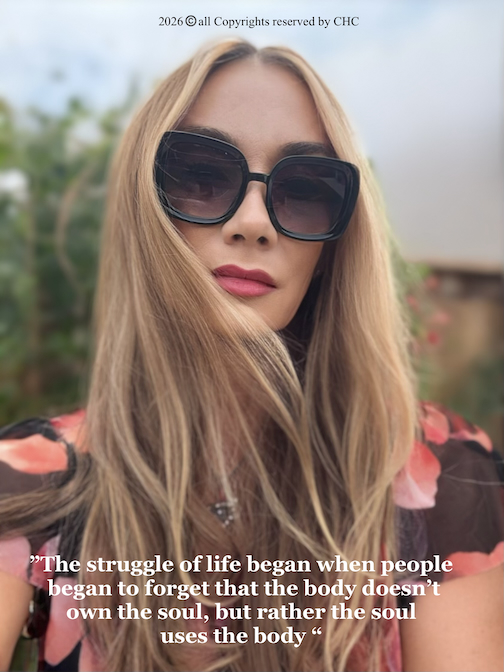
This profound concept addresses the core of spiritual dualism, asserting that human existence shifted toward a survival struggle when you lost touch with your true nature.
The quote heavily shared and popularized by Clarissa Helene Constantinos, an author and spiritual teacher associated with Syban Church, an online spiritual community and creative philosophy platform. Her teachings focus on transforming life from a “passive experience into an active creation” by viewing reality as a “game of souls.”
Breaking Down the Meaning
The Body vs. The Soul: In this philosophy, your physical body is not your identity. It is merely a temporary vessel, a tool, or a vehicle. The true “you” is the immaterial soul.
The “Struggle for Life”: When people assume they are their bodies, they become consumed by the material world. This triggers a survival mindset governed by fear, bodily desires, and existential panic.
The Soul Uses the Body: By shifting perspective to recognize that the soul animates and uses the body to navigate the physical world, life stops being a frantic struggle to survive. Instead, it becomes a purposeful journey of experience and self-realization.
This perspective aligns closely with ancient philosophical traditions, notably Plato’s radical dualism, which similarly treated the body as a temporary “prison” or tool and the soul as the true, immortal self driving human action.
This concept shifts your perspective from being a physical entity having a spiritual experience to being a spiritual entity navigating a physical experience. Repeating this core tenet highlights its central importance to understanding human suffering and purpose.
The Core Philosophy Breakdown
When you look at this idea deeply, it reveals why daily life can feel like such an intense battlefield:
The Shift to Materialism: The “struggle” refers to existential anxiety, greed, fear of death, and the endless pursuit of physical security. When humanity collectively forgot its spiritual origin, we began treating the body as the ultimate owner of our identity.
The Illusion of Control: If the body owns the soul, then keeping the body safe, fed, young. and comfortable becomes the absolute meaning of life. This naturally creates a fierce competition and conflict with others to secure limited physical resources.
The Soul as the Driver: Recognizing that the soul uses the body completely changes the dynamic. The body becomes a beautifully designed instrument—a bio-vehicle-allowing the soul to feel, learn, create, and experience the density of the physical world.
Ancient Roots & Modern Echoes
While popularized within modern esoteric and spiritual teachings, this exact distinction has been echoed across centuries of philosophy:
Platonic Philosophy: Plato argued that the soul belongs to a higher realm of ideals, while the body belongs to the flawed, changing material world.
Eastern Traditions: Many Vedic and Buddhist philosophies teach that the physical form is merely a garment or temporary vessel (upadhi) that the true self (Atman or consciousness) wears for a single lifetime.
Modern Thought: Spiritual authors like Dr. Wayne Dyer famously rephrased this eternal truth by reminding people to see themselves as “a soul with a body rather than a body with a soul.”
By remembering that your body is the instrument and your soul is the musician, the frantic struggle for survival gives way to a deeper, more intentional way of
This reflection on the interplay between body and soul touches upon a profound philosophical and spiritual theme central to humanity. The quote by Clarissa expresses a perspective also found in many classical schools of thought and mystical traditions.
Here are the key ideas derived from this statement: The quote radically inverts the usual assumption: the soul is the true constant, whereas the body is the transient tool or vehicle through which the soul expresses itself in the physical world. The focus shifts to mere survival and material protection.
Loss of inner guidance: When the instrument (the body and its purely biological drives) takes the lead, the individual loses the deeper orientation and purpose actually dictated by the soul (higher consciousness). Platonic philosophy, too, often describes the body as the “vessel” or even the “prison” of the immortal soul, which must experience the material world through it.
This sentiment deeply echoes a famous philosophical perspective: we are not physical beings having a spiritual experience, but spiritual beings having a physical one.
While the exact phrasing of Clarissa is a unique poetic take on the human condition, it directly mirrors the core meaning of a highly popular, misattributed quote: “You don’t have a soul. You are a soul. You have a body.” Though often credited to author C.S. Lewis, literary researchers have traced its actual roots back to the 19th-century Scottish minister and writer George MacDonald, who was a major mentor and inspiration to Lewis.
The Evolution of the “Soul Using a Body” Idea
The concept that the soul merely “uses” or inhabits the body as a vehicle has a massive history stretching across thousands of years of philosophy:
Plato’s Dualism: In ancient Greece, Plato argued that the soul is immaterial, immortal, and fundamentally trapped inside the physical body. To Plato, the body is a temporary “prison” or an impediment to the soul’s true purpose
Augustine’s Christian Twist: Centuries later, St. Augustine adapted Plato’s ideas into early Christian theology. He explicitly defined a human being as a “soul using a body,” viewing the physical self as a good but fallen vessel meant to serve the soul’s journey toward God.
The Counter-Argument (The Unified Self): Not all thinkers agreed with this split. Philosophers like Aristotle and later Thomas Aquinas pushed back against the idea that the body is just an object the soul “uses”. They argued for a more unified existence, stating that a human being is a complete, inseparable blend of both body and soul working together as one entity.
When a society or person flips that balance—forgetting the spiritual essence and focusing strictly on the material—existence can quickly feel like a desperate “struggle for life” driven entirely by physical desires, survival instincts, and material possessions
This statement means that human suffering begins when you mistake temporary physical desires for the true, eternal needs of your inner self.
The Core Idea
The Body as a Tool: The body is a temporary vehicle or instrument. It helps you to act and experience the physical world.
The Soul as the Driver: The soul is the true, lasting essence of who you are. It guides the body.
The Root of the Struggle: Problems start when you serve the physical body—chasing comfort, status, or control—while starving the spirit.
Why This Causes Struggle
False Ownership: When you think you are only flesh and bone, you fear aging, pain, and death.
Lost Purpose: Focusing only on physical survival makes life feel empty and competitive.
True Peace: Remembering the soul brings calm because the inner self is not harmed by temporary physical changes.