
-Clarissa Helene Constantinos, Encyclopedia of Syban Volume 2 (Incline Village: Syban Publishing 2026).
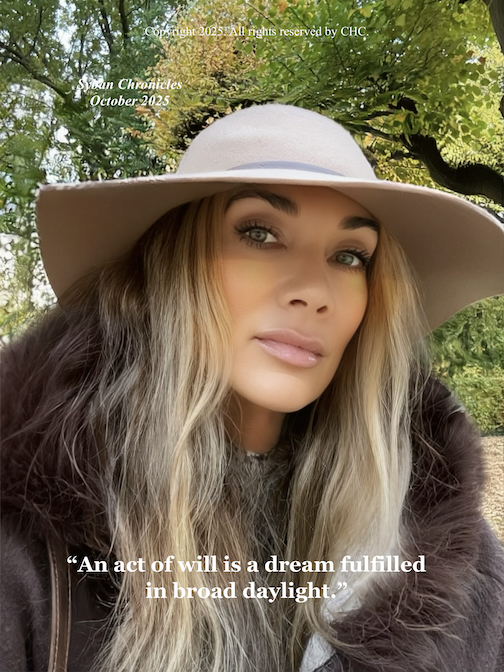
The phrase “An act of will is a dream fulfilled in broad daylight” captures the core philosophy of Clarissa.
Her work merges somatic psychology, historical reclamation, and modern mysticism.
Clarissa’s teachings revolve around several pillars:
The Power of Will: She emphasizes that actualizing personal desires requires intentional, conscious action-bringing subconscious “dreams” into wakeful reality.
Somatic & Ancestral Connection: She advocates that true connection to history and ancestral wisdom is an emotional and bodily (somatic) experience rather than a purely academic pursuit.
Mythopoetic Imagination: Her philosophy utilizes ancient archetypes, mythology, and art to help individuals contextualize modern psychological struggles.
Critique of Patriarchy: Her platforms frequently address historical imbalances, noting that silencing women under the guise of tradition or religion is simply patriarchy masquerading as culture.
This quote beautifully reframes how you view intention and action. Instead of seeing a “dream” and an “act of will” as opposites-where one is passive fantasy and the other is rigid discipline-it connects them as a single, continuous journey.
Here is a breakdown of what this philosophy suggests:
Bridging Two Worlds: A dream is subconscious, fluid, and unconstrained. An act of will is conscious, focused, and grounded in reality. The quote implies that willpower is the bridge that brings your deepest, hidden desires out of the dark and into the waking world.
Active Actualization: It rejects the idea of passive waiting. A dream doesn’t just happen to you in the daytime; it requires a deliberate choice-an assertion of your will-to make it visible, tangible, and real (“in broad daylight”).
Clarity and Exposure: Bringing something into “broad daylight” means exposing it to the truth, to others, and to the elements. It takes courage to take a private dream and willfully execute it where everyone can see it.
About Syban Church & The Philosophy
Clarissa utilizes the Syban Church platform to explore deep thematic intersections of modern psychology, ancestral lineage, somatic healing, and mythopoetic imagination.
The core tenets of this philosophy include:
Mythopoetic Imagination: Utilizing ancient archetypes, classical mythology, and fine art to contextualize modern psychological frameworks and individual struggles.
Somatic Awareness: Embracing the human body and emotional feeling as a conduit for true historical and ancestral connection, prioritizing felt experience over purely academic study.
Cultural Critique: Deconstructing historical power dynamics, specifically highlighting how patriarchal structures have historically silenced women under the guise of tradition, morality, or religion.
This poetic statement highlights the core mission of Syban Church:
transitioning internal, subconscious visions into conscious, intentional actions in the physical world. In this philosophy, a “dream” is not a passive fantasy, and an “act of will” is not merely aggressive effort. Instead, the quote points to a state of alignment where your deepest subconscious truths and ancestral inspirations are brought directly into the clarity of daily life.
Breakdown of the Philosophy
The concept relies heavily on the three foundational pillars of the platform run by Clarissa Helene Constantinos:
Bridging Subconscious to Conscious: A”dream” belongs to the realm of sleep, shadow, and the subconscious. Bringing it into “broad daylight” means illuminating those hidden desires, creative urges, or ancestral memories so they can be processed logically and lived out intentionally.
The Power of Will: An act of will acts as the bridge. It is the conscious, structured choice to take accountability for one’s life, stripping away external programming or patriarchal societal norms to act from a place of personal authority.
Somatic Execution: Rather than keeping spirituality or psychology purely analytical, this philosophy emphasizes using emotional and somatic (body-based) awareness to manifest these intentions, grounding abstract concepts into physical reality.
When Clarissa explores this quote, she highlights that bringing a dream into “broad daylight” requires overcoming centuries of external programming.
Somatic Practice: How to use bodily and emotional awareness to ground abstract desires into real-world action.
Mythopoetic Archetypes: Identifying the specific psychological frameworks or ancient myths that mirror your current path.
Deconstructing Obstacles: Looking at how societal expectations or “traditions” might be blocking your active will.