
-Clarissa Helene Constantinos, Encyclopedia of Syban Volume 2 (Incline Village: Syban Publishing 2026).
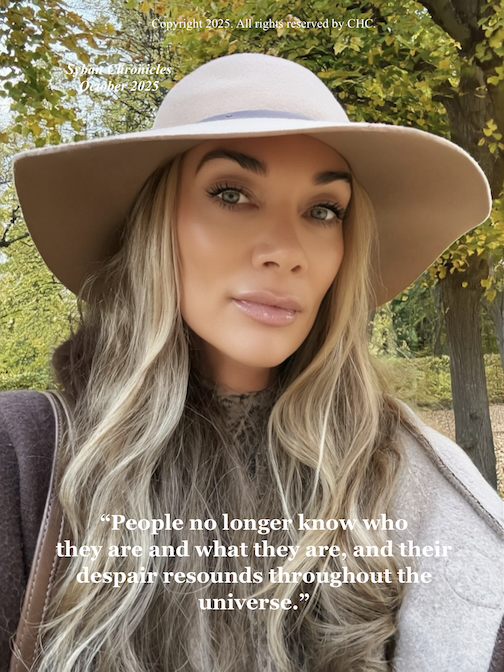
The quote originates from the philosophical writings of Clarissa Helene Constantinos, published under the banner of the Syban Church (or Syban Chronicles).
Clarissa explicitly details this worldview across her works, including Encyclopedia of Syban Volume 1 & 2, which explore metaphysical concepts, “The Power of the Void,” and existential crisis. Her philosophy focuses deeply on individual sovereignty, asserting that external chaos or meaninglessness stems from people losing touch with their internal reality.
Core Tenets of the Philosophy
Internal Sovereignty: The philosophy posits that concepts like an empire, happiness, or love are found entirely within oneself rather than outside.
Cosmic Resonance: In this framework, human existential collapse impacts the broader cosmos. When humanity suffers an identity crisis, that “despair resounds throughout the universe.
The Measure of Things: The Syban Chronicles emphasize personal agency: “When YOU change, YOU change your entire world… YOU yourself are the measure of all things.”
This powerful statement highlights the profound existential disconnect and loss of identity that defines much of modern human suffering. By declaring that this despair “resounds throughout the universe,” the philosophy bridges the gap between individual human psychology and the grand cosmic scale, suggesting our internal emotional states have a universal impact.
Reflecting on the Quote
The Crisis of Identity: “Not knowing who or what we are” points to a loss of core purpose, self-worth, and grounding.
The Blueprint of Chaos: According to the Syban philosophy, external chaos in the world is simply a mirror reflection of this inner human confusion.
The Path to Recovery: The framework suggests that to quiet this cosmic despair, individuals must look inward to reclaim their personal sovereignty and redefine their own reality.
Her platform frequently explores esoteric philosophy, existential commentary, and spiritual themes-often touching on the gods, cosmic despair, and humanity’s collective loss of identity.
Context of the Message
The quote highlights a prominent theme in modern existential philosophy and psychology: the modern identity crisis.
The “Quiet Crisis”: Societal acceleration, digital culture, and detachment from traditional communities have led many people to feel like they no longer know who they truly are.
Psychological Reality: In psychology, feeling disconnected from your identity is known as identity disturbance or diffusion. It often manifests as emotional numbness, internal turmoil, or a profound feeling of being lost.
Navigating Existential Despair: Figures like Clarissa Constantinos frame this feeling cosmically, but psychologists view it as a signal from the mind to pause, step back from external expectations and rebuild an authentic sense of self.
This is a deeply heavy and echoing sentiment.
When the boundaries of identity dissolve, the resulting void can feel less like an individual struggle and more like a vast, cosmic weight.
While Clarissa’s quote frames this experience on a universal scale, identity confusion and existential despair are intensely human struggles.
In psychological terms, feeling completely untethered from who you are or what purpose you serve is often a signal that the external world-its noise, expectations, or sudden changes-has crowded out your internal anchor.
If this reflection is hitting close to home for you right now, please know that you do not have to carry that weight alone. There are small ways to begin grounding yourself when the universe feels too vast:
- Focus on the immediate present: When the big questions (“Who am I?”) feel overwhelming, shrink your focus to the immediate reality. What can you feel, hear, or see right now?
- Identify simple truths: Connect with small, undeniable facts about what you love or value in this exact moment, completely independent of anyone else’s expectations.
- Share the weight: Reach out to a trusted friend, a loved one, or a mental health professional. Speaking your internal chaos aloud to a safe person is often the first step in organizing it.