-Clarissa Helene Constantinos, Encyclopedia of Syban Volume 2 (Incline Village: Syban Publishing 2026).
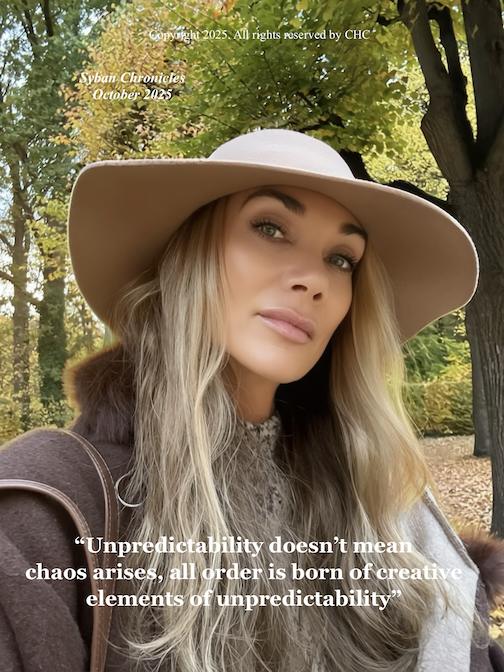
This quote beautiful encapsulates the perspective of Clarissa Helene Constantinos, the creator and founder of the Syban Church community.
Her philosophy focuses on a decentralized, dogma-free approach to spirituality, often exploring how spontaneous, unpredictable elements are necessary forces for genuine creation.
By separating unpredictability from chaos, this thought reminds us that:
Unpredictability is a catalyst: It represents the open space of potential before a new pattern forms.
Static systems brittle: Without an element of the unexpected, structure becomes rigid and stagnant.
Order requires a spark: True, adaptive order is a creative act that requires a dynamic, changing environment to be born.
This quote highlights the delicate boundary between structure and spontaneity. It posits that predictability is not the enemy of stability; rather, true stability-or order-requires the fluid, adaptable space of the unexpected to form in the first place.
When looking at this concept through different lenses, the idea manifests across several domains:
Self-Organizing Systems: In physics and complex systems, systems that are completely static eventually break. Robust, self-organizing order only emerges when a system is disturbed by fluctuations or unpredictable inputs, forcing it to find a higher level of equilibrium.
The Creative Process: True creativity cannot exist in a perfectly mapped-out environment.
The creative process relies on a “spark” of the unexpected-a sudden intuition, an accidental detour, or a disruption of routine-to forge something completely original.
Spiritual and Personal Philosophy: From a personal growth or decentralized spiritual standpoint, viewing uncertainty not as a threat (chaos) but as a canvas for creativity allows a person to build a more dynamic, resilient way of living. It reframes the unknown from something to fear into something to create with.
Order is born of creative unpredictability. This perspective shifts the view of randomness from a destructive force to the very catalyst for structure and creation.
In fields like complex systems, physics, and evolutionary biology, true order rarely emerges from static, predictable environments. Instead, it requires a spark of unpredictability-mutation, fluctuation, or creative chaos-to disrupt the old status quo and allow a more complex, adaptive order to organize itself.
Without unpredictability, systems become rigid, stagnant, and brittle. With it, they become generative.
Clarissa’s teachings often revolve around communal alignment with “higher light,” spiritual “spirit teams,” and reframing life’s unexpected shifts not as destructive forces, but as divine orchestration.
In this context, the statement acts as a metaphysical reminder: when life feels unpredictable, it isn’t devolving into chaos. Instead, that very unpredictability is a creative, necessary force shaping a higher, more aligned spiritual order.
That is a profound perspective that elegantly challenges the classical view of order and chaos. Instead of regarding unpredictability as a threat to structure, Clarissa describes it as the very breeding ground for genuine, dynamic order.
In many systems—whether in nature, art, or innovation—rigid predictability often leads to stagnation (entropy). It is only through the unpredictable, creative element that the old breaks down, enabling new, more complex structures to form in the first place. Order, therefore, is not a static state but an ongoing, creative process.
Unpredictability helps create new kinds of order instead of just making random chaos.
This idea connects closely to science and philosophy, especially how complex systems work.
How Order Grows
Emergence: Small, unexpected events combine to form stable patterns.
Natural Examples: Flocks of birds change direction instantly without a leader. Water molecules move randomly, yet they form smooth flowing rivers or ice crystals.
Flexible Systems: Rigid rules break under pressure. Systems with a touch of unpredictability adapt and survive.
Why It Is Creative
No Stagnation: Complete predictability leads to repetition and a dead end.
New Solutions: Surprise and random variation allow evolution and fresh ideas to appear.
Growth: Life needs a balance between stability and surprise to move forward.