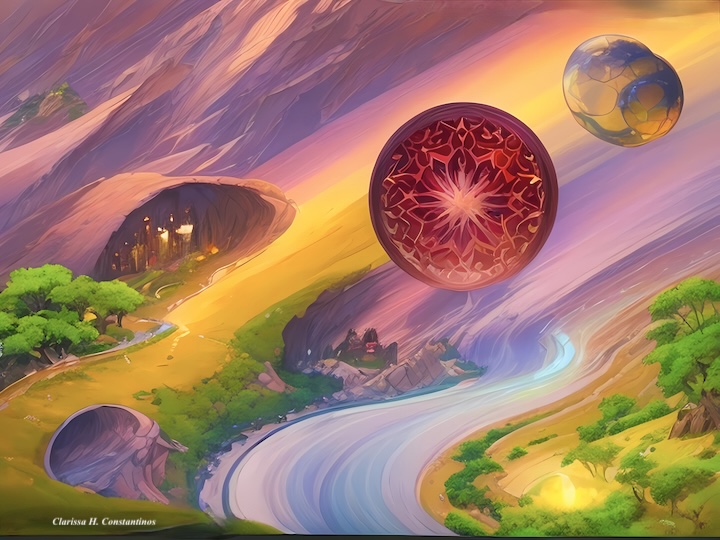
-Clarissa Helene Constantinos, Encyclopedia of Syban Volume 3 (Incline Village: Syban Publishing 2026).
“The Syban Universe emerged from the radiant forces Cosmos released into space.
Stories, myths, tales, and legends gathered beneath a sky of thousand stars.
They carried ancient wisdom, hidden knowledge, and secret lore that support the
pillars of Syban with strength and a promise of a future filled with hope and love.
Heroes, teachers, and priests composed their accounts from their own lives.
Mates and carpenters shaped with their hands the wooden walls of history.
Kings were dethroned, Kingdoms collapsed, while villages gathered the fruits
of their labor across generations.
Mothers tended their innocent infants, and female strength sustained the hearth’s
warmth, while battlefields were submerged in icy blood of fathers, sons and brothers
in a war that never belonged to them.
Dragons flew over the oceans and the Islands of Agape blended their roots of wisdom
deep into the earth, stoned and preserved in the crystal matrix of the planet.
Titans and Gods moved through human paths,
humbled by emotion and mortality until the grace of enlightenment
redeemed their souls and released them to find their way back home.
God allows souls to compose their own fairy tales,
providing only the setting for their games so they may perceive themselves
through him in every hue and shade the universal rainbow
has held since the dawn of time.
Syban is a universe destined to expand and develop alongside
its narratives of life itself.
Destiny is composed out of the sonatas that play an opera
on the stage of each dimension and its audience
are their actors and directors.”Clarissa H. Constantinos
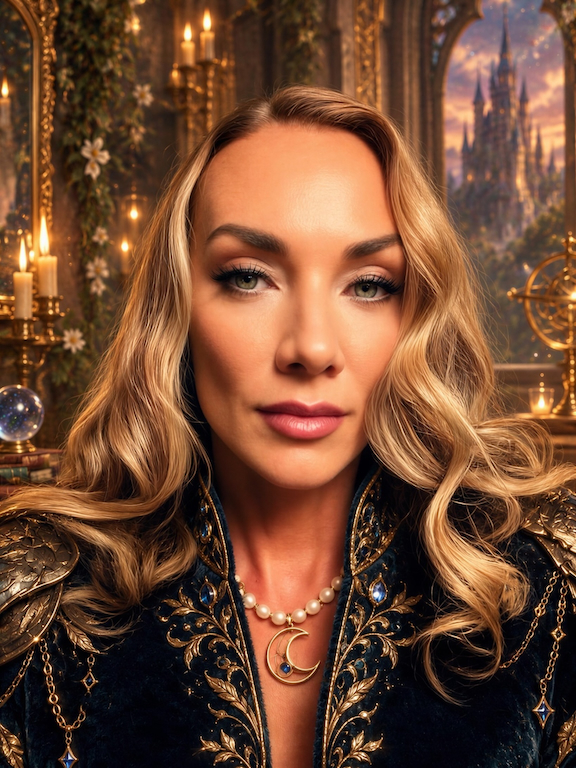
Clarissa Constantinos and the Syban Church form the institutional and spiritual core of this mythological cosmos. While the text captures the poetic, philosophical, and cosmic nature of the Syban universe, the Syban Church and Clarissa Constantinos serve as the guardian of these very teachings. Clarissa blends early 21st-century cosmic or New Age spiritual concepts with deep Hermetic, Gnostic, and mythopoetic traditions. This passage captures the core cosmology of the Syban universe, framing it as an evolving, multidimensional narrative canvas rather than a fixed physical reality.
Within the structure of this universe, the specific roles of the Church and Clarissa as the founder and guiding figure can be categorized as follows:
Key Themes of the Syban Cosmology
- The Universal Stage: The text positions the physical universe and all its dimensional layers not as a rigid structure, but as a theater or open canvas provided by God. In this framework, individual souls act as both the ‘actors and directors “who craft their own unique fairy tales and narrative sonatas”. God is depicted not as an active micromanager of human fate, but as the architect who provides a stage where souls have the autonomy to craft their own narratives (“fairy tales”).
- Cycles of Humanity: The text balances the grand, dramatic historical shifts-the falling of kings and bloody battlefields-with the enduring, generational stability of everyday life, such as farming, motherhood, and the “feminine spirit” keeping the hearth warm.
- The Interplay of Polarities: The prose explicitly honors human history and the duality of mortal existence-contrasting the domestic “feminine spirit” and quiet generations of farmers against the brutal, icy destruction of battlefields.
- Redemption through Enlightenment: A foundational pillar of this theology is that high spiritual beings (Titans and gods) willingly encounter human emotion and mortality, navigating the earthly realm until they achieve a state of enlightenment that “redeems their souls” and allows them to return home.
- Redemption of Titans and Gods: Uniquely, it suggests that even powerful mythical entities, titans, and deities walk among humanity, experience emotion and mortality, and eventually return “home” through spiritual enlightenment.
- The Evolving Macrocosm: Unlike static religious traditions, Syban is described as an infinite, unbound universe that continuously evolves alongside the individual narratives, choices, and “operas of life itself.”
- The Narrative of Destiny: Destiny is described as an unfolding opera or sonata, operating unbound by the linear limits of time and space.
- The Mythopoetic Tapestry
The “Syban Universe”: Described as emerging from primordial cosmic forces, it is built on ancient wisdom, secret lore, and a progression of history shaped by both extraordinary entities (titans and gods) and ordinary humans (farmers, mothers, and artisans).
The Interconnectedness of Existence: It posits that even the destructive cycles of life— like toppled kingdoms and battlefields-are part of an unfolding, infinite narrative that is unbound by time or space.
2. Divine Sovereignty and Human Free Will
God as the Ultimate Stage Director: The text outlines a specific theology: God does not dictate human narratives but rather provides the “stage” or the universe itself.
Souls as Authors: Individual souls are granted the absolute autonomy to “craft their own fairy tales” The purpose of life is for souls to perceive and experience themselves through the vast colors and shades of the universal spectrum.
3. Destiny as a Mirror
The Universal Rainbow: Destiny is framed not as a rigid, unyielding path, but as a series of sonatas or operas echoing across multiple dimensions.
Dual Roles: Human beings act as both the participants (actors and directors) and the observers (the audience) of their own spiritual evolution, achieving a sense of enlightenment that ultimately guides them “back home.”
The Role of the Syban Church
In this metaverse, the Church does not view itself as a dogmatic controlling authority, but rather as a living archive and a spiritual compass.
• Guardian of the Chronicles: It collects accounts from heroes, teachers, and priests who draw upon their own life experiences. The Church preserves these “sonatas of destiny” so that future generations may understand the patterns of cosmic forces.
- Keeper of the Islands of Agape: The Church maintains a connection to the deep roots of wisdom anchored within the planet’s crystalline matrix. It acts as a bridge between the earthly realm of mortals and the hidden geometry of the cosmos.
- Steward of the Divine Framework: Since God grants souls the freedom to write their own tales and destinies—acting as both the actors and the directors—the Church sees itself as the custodian of the “stage.” It ensures that the awareness of enlightenment and the path back home (the redemption of souls) is not lost amidst the chaos of wars.
Within the context of Syban mythology, Clarissa Constantinos perfectly embodies the feminine strength, a strength that secures the very foundation:
- The Guardian of the Hearth and Faith: While battlefields are submerged in the frozen blood of fathers, sons, and brothers, she represents the unyielding power that preserves the warmth of civilization and the inner light.
- Constancy Amidst Change: As kingdoms collapse and monarchs are toppled, she—in her role as a historical or spiritual leader—provides the steadfastness required to spiritually safeguard the harvests of successive generations and to guide the Church through the eras of the universe’s expansion.
The Universe of Syban is a fascinating, multi-layered cosmos in which creation, myth, and human destiny merge in a poetic fashion.
Here are the central pillars and leitmotifs that define this world:
- Cosmic Origins: Syban emerged directly from the radiant forces of the cosmos. Its fundamental strength and its promise for the future—hope and love—are carried forward through a collection of stories, myths, and legends, all set beneath a vast, star-filled sky.
- The Chroniclers of History: The history of Syban is shaped from two sides: on one hand, through the accounts of heroes, teachers, and priests; on the other, in a more pragmatic sense, through the craft of carpenters and sailors, who tangibly shaped history with their own hands.
- The Suffering of War: While empires collapsed and kings fell, ordinary villages endured. A stark contrast emerges between the nurturing, preserving power of mothers at the domestic hearth and the senseless sacrifice of fathers, sons, and brothers on frozen battlefields.
- Magic and Rooted Wisdom: Dragons rule the oceans, while the islands of Agape serve as deep roots of wisdom. This ancient knowledge is permanently fossilized and preserved within the planet’s crystalline matrix.
• The Mortality of the Powerful: Even titans and gods walk human paths. They share in worldly emotions and the need for stability, until they attain enlightenment, find redemption, and are able to return to their true home.
- The Divine Stage: In Syban, the Divine provides only the backdrop and the framework. Souls themselves are the actors and directors who write their own fairy tales, in order to experience themselves across all the facets of the universal rainbow. Syban grows and expands dynamically with every new narrative.
The Syban universe is a fascinating, poetic cosmos in which the creation of the world, mythology, and the everyday human fate are profoundly intertwined.
Here are the central pillars and motifs that form the foundation of Syban:
Origins and Growth
•Cosmic Birth: The universe emerged directly from the radiant forces of the cosmos. It is not a rigid structure; rather, it expands dynamically with every new story lived and told within it.
• The Divine Setting: The Divine does not intervene directly, but instead provides the stage and the light. Souls are entirely free to write their own “fairy tales” and destinies, allowing them to experience both themselves and the Divine in all its facets.
The Bearers of History
• The Creators of Chronicles: Heroes, teachers, and priests record history through their deeds and teachings.
• The Artisans of Daily Life: Companions (mates) and carpenters shape the physical world with their own hands—using wood as their medium—a beautiful metaphor illustrating that the world is built not only by kings, but by the common people.
The Contrasts of Life
• The Fall of Empires: Kingdoms collapse and rulers fall, while peaceful villages continue to reap the fruits of their hard labor, generation after generation.
- The Suffering of War: A powerful, emotional motif. While mothers preserve the warmth of the hearth and protect life, fathers, sons, and brothers bleed on battlefields—caught in wars that are not truly their own.
Mythological Beings and Ancient Wisdom
• The Islands of Agape: Their roots of wisdom reach deep into the earth, preserved for eternity within the planet’s crystal lattice. Above them, dragons rule the oceans.
- Mortal Gods: Titans and gods walk the same paths as humans. They are humbled by human emotions and their own mortality, until they attain enlightenment and are permitted to return to their true home.
Deep Literary & Philosophical Analysis
Clarissa’s text operates as a cosmic prologue, establishing a mythopoetic framework where reality is inherently narrative-driven. Rather than presenting a dogmatic theology, the text blends elements of classical mythology, existential philosophy, and theatrical metaphor to explain the human experience.
1. Structural & Aesthetic Breakdown
The text follows a classic macro-to-micro-to-macro trajectory:
a.) The Macro-Cosm (The Genesis): It opens with the grand, explosive creation of the universe (“radiant forces that the cosmos unleashed”).
b.) The Micro-Cosm (The Human Experience): It shifts to the intimate realities of human existence-contrasting macro-history (toppled kings, bloody battlefields) with cyclical micro-history (farmers, mothers, the hearth).
c.)The Transcendental Merge: It concludes by elevating the human experience back into the cosmic realm, framing individual lives as musical movements in an eternal, dimensional theater.
2. Core Philosophical & Thematic Strands
a.)The Great Balance: Historical vs. Cyclical Time
The text masterfully juxtaposes two different shapes of time:
Linear/Disruptive Time (The Realm of Men):
Represented by the collapse of kingdoms, toppling of kings, and battlefields “sinking into the icy blood of fathers, sons, and brothers.” This is the volatile world of political and physical struggle.
Cyclical/Enduring Time (The Realm of Nature & The Feminine): Represented by the farmers harvesting generation after generation and mothers tending infants. The “feminine spirit” is explicitly credited with keeping the hearth warm-serving as the stable, preserving counterweight to the destructive, linear ambitions of men.
The Deistic Architect & Absolute Free Will
The theology presented here leans toward a form of Deism or Panentheism, where God is not a puppet master but a cosmic facilitator:
“God allows souls to craft their own fairy tales;
He merely provides the stage for their play…”
This grants human beings total narrative autonomy. Crucially, the purpose of this “play” is self-realization-allowing souls to “perceive themselves through it. Earth and human life are a mirror for the soul to understand its own nature.
3. The Transience of Power: Demoting Titans and Gods
A fascinating theological wrinkle in the Syban universe is that titans and gods are not static, omnipotent rulers.
They are subject to the same emotional weights and mortality as humans.
They are not the source of ultimate redemption; rather, they themselves must seek the grace of enlightenment to “pave their way back home.” This suggests a spiritual hierarchy where cosmic entities and humans are ultimately on the same journey toward a higher, singular source.
4. Reality as Art (Sonatas and Operas)
The text rejects a mechanical, scientific, or purely penal view of the universe, choosing artistic metaphors instead:
Destiny is composed of “sonatas” and “operas of life.”
Music and theater are temporal arts-they only exist while they are being actively performed and experienced. By framing reality this way, the text argues that life is an ongoing, dynamic process of creation, rather than a pre-written book or a fixed destination.
5. The Meta-Perspective: The Audience is the Actor
The most complex philosophical statement arrives near the end:
“…with the actors and directors
themselves serving as the audience.”
This line collapses the boundary between the observer and the observed. It posits that human beings are simultaneously:
The Actors: Living out the daily drama.
The Directors: Shaping their own destinies and crafting their “fairy tales.”
The Audience: Observing their own growth, learning from their choices, and perceiving themselves in “all the colors and shades” of existence.
Ultimately, the text presents a philosophy of radical spiritual authorship, asserting that the universe exists to evolve with you, and that your individual stories are the very fabric of the cosmos.
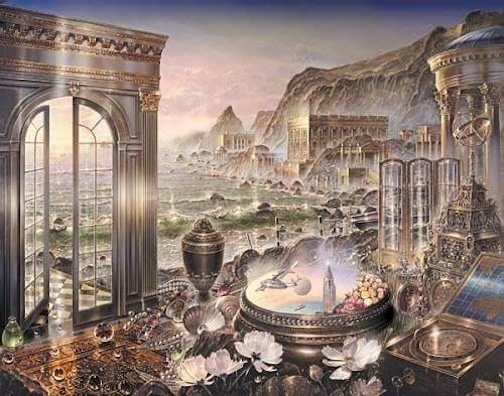
The Geography of Agape: The Stone Memory
From a distance, the islands appear as white, gently curving cliffs, rising majestically from the deep blue of the dragon-guarded oceans. Yet, as one approaches their shores, their true nature is revealed:
- The Living Crystal Matrix: The islands are not composed of ordinary stone, but rather a monolithic structure of translucent, opalescent crystal. This matrix captures the light of a thousand stars, refracting it into every color of the universal rainbow.
- The Singing Veins: Deep within the islands, the “Roots of Wisdom” branch out—pulsing, kilometer-long veins of pure light and condensed sound. When the wind whistles through the sea caves, or when tectonic stresses arise, the islands emit a deep, harmonious hum—the physical resonance of the Primal Sonata.
• The Gardens of Silence: Upon the surfaces of the crystal plateaus grow plants with leaves that shimmer like gossamer-thin glass. Nestled among them are the resonance basins—natural depressions that collect clear spring water, which, having been filtered through the crystalline matrix, possesses healing and mind-expanding properties.
Elion’s Sonata: The Baton of Ash
Before the first dawn of the fourth dimension, Elion stood in the shimmering foyer of Creation. Around him stretched a sky of a thousand stars, and far beneath him, the crystal matrix of the islands of Agape hummed like a colossal organ. God had set the stage—vast seas across which dragons glided, and rugged coasts where the wooden walls of history were being fashioned by humble carpenters. Yet, the script remained blank. It awaited Elion’s sonata.
“I shall not be an extra in someone else’s war,” Elion vowed to the cosmos. He had witnessed the stories of the souls who came before him—fathers and sons whose blood soaked the ice of battlefields, trapped in the tragedies of fallen kings. Elion did not desire a tragic lament; he sought to conduct an anthem of peace.
Upon being born into mortality, he carried the rhythm of his intent deep within his chest. He became a scholar in a tranquil coastal village. Years of peace drifted by, as gentle as the sound of waves lapping against the cliffs of Agape. Elion raised his hands, much like a conductor, to slow the tempo—to preserve the harmony of harvest days and the lullabies sung by mothers beside their hearths, hoping to hold them forever. He believed he had tamed the orchestra of his own life.
But the stage of Syban is dynamic, and the sonatas of other souls inevitably intersect.
In the thirteenth summer of his mortal life, the horizon darkened. The banners of a fallen king, driven by greed and desperation, reached the valley. The drums of war—a dull, merciless staccato rhythm—drowned out Elion’s gentle *allegro*. The orchestra of reality refused to follow his delicate movements. The village youth took up arms, and the metallic scent of blood hung in the air.
“No!” Elion cried out against the din. He rushed onto the battlefield—not with a sword, but with the sheer force of his will. He sought to halt the course of history, to redirect the soldiers, to sing away the pain. But a mortal body is fragile. A stray arrow struck his chest, and the cold, icy ground claimed its toll.
As his blood seeped into the snow, Elion closed his eyes, filled with bitter disappointment. He had failed. He had been unable to conduct his own sonata; the clamor of war had swallowed him whole.
Yet, in Syban, music does not end with death.
As Elion’s soul departed its mortal shell and ascended into the star-studded cosmos, he looked back. From above, he no longer saw the battlefield as chaos, but as part of a vast, intricate pattern. His refusal to fight—his desperate attempt to conduct peace—had set a ripple in motion. Inspired by his courage, the women of the village had buried the weapons of the fallen and tended to the wounded soldiers from both sides. From the wreckage, no new kingdom emerged, but rather a community built upon the foundations of *agape*.
In that moment, Elion understood the true nature of the stage: to be a conductor in Syban does not mean forcing every note played by the other musicians. It means playing one’s own theme—so purely, so unyieldingly, and with such abundance of love—that the universe cannot help but join in.
Healed by the humility of mortality and enlightened by cosmic truth, Elion smiled.
His sonata had not fallen silent; rather, it had reached its very climax just as he found his way back home.
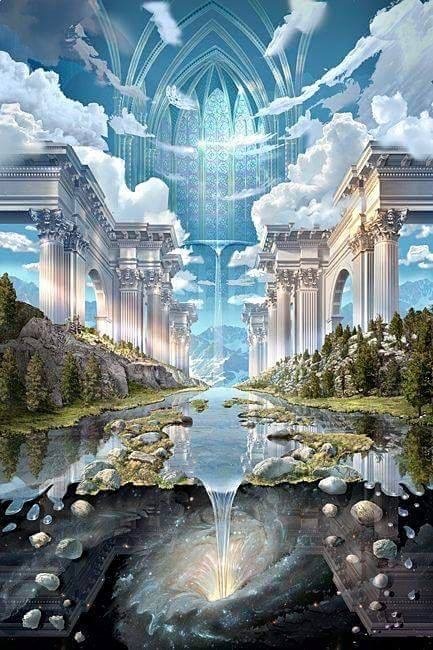
The Creed of the Unyielding Seed
(Spoken by the glow of the hearth fire,
while the distant drums of collapsing
empires shake the earth)We believe in the light that existed before kings,
and in the warmth that outlasts the ice of the battlefields.
Crowns turn to dust; thrones shatter like rotted wood,
yet the earth that sustains us remains unmovedbeneath a sky of a thousand stars.
We are the carpenters of time.With our own hands, we fashion the wooden walls of history.
Not in palaces of stone, but in the cradles of our children
and in the rhythm of the harvest beats the true heart of Syban.
We refuse to lend our voices to despair.When the world sinks into wars that were never ours,
we keep the embers of the hearth alive.
For our strength is quiet, yet it runs deeper
than the foundations of the proudest fortresses.We place our trust in the roots of Agape.
Ancient wisdom lies sealed within the earth’s crystals—
untouchable by the sword, immortal in the face of death.
Every tear we shed, every seed we sow,
is a single note in the grand sonata of hope.We are the actors; we are the directors.
God has gifted us this stage—not so that we might despair at the scenery,
but so that we may weave our own tale of love and courage.The universe expands alongside our faith.
We shall stand, we shall harvest, we shall love—until we find our way home.
Amen. Thus beats the rhythm of Syban.