-Clarissa Helene Constantinos, Encyclopedia of Syban Volume 3 (Incline Village: Syban Publishing 2026).

“The Judgment of Paris continues to shape the forces that govern world events to this day.
Paris chose the beauty and love offered by Aphrodite—
thereby rejecting both the political power and earthly dominion promised by Hera,
and the wisdom, military might, glory, and triumph held out by Athena.
The “golden apple for the fairest” unleashed a chaos that brought ruin
across the entire Mediterranean region for decades.
Hector paid with his own blood for the final vestiges of honor;
Cassandra’s prophecy gave a new, fateful turn to the immortality of Achilles;
and the Trojan Horse brought about the collapse of the empire from within.
The fall of Troy laid the foundation for the Rome of Caesar—a Rome that harbored within itself the same patterns of abuse of power
and betrayal that would later be revealed through Brutus and his 23 co-conspirators.
History repeats itself according to a pattern firmly anchored in the matrix—
until shifts in the fabric of destiny spin the wheel of fate with renewed momentum,
giving rise to new structures that allow for freedom, prosperity, and peace.
Consequently, infinite golden apples will grow in every garden, and their
radiance will cast a clarifying light upon envy, greed, sorrow, and jealousy.”
Clarissa H. Constantinos
This text originates from the mythopoetic cosmos of Clarissa Helene Constantinos, founder of the Syban Church. It weaves together classical narratives from Greco-Roman antiquity with the Gnostic-esoteric theology of her teachings.
This text beautifully captures the core of mythopoetic philosophy, examining how ancient cycles of myth repeat across human history. It links the teachings of Clarissa Helene Constantinos and the Syban Church to the classic theme of the “net of fate”.
Clarissa’s text weaves a dense web of Greek mythology, Roman history, and cosmic philosophy to demonstrate how human frailties have, for millennia, fueled the same destructive cycles. It employs the Trojan War and the fall of Rome as metaphors for the abuse of power, yet ultimately reveals an almost utopian shift toward a healed world.
Here is a breakdown of the core motifs and their significance:
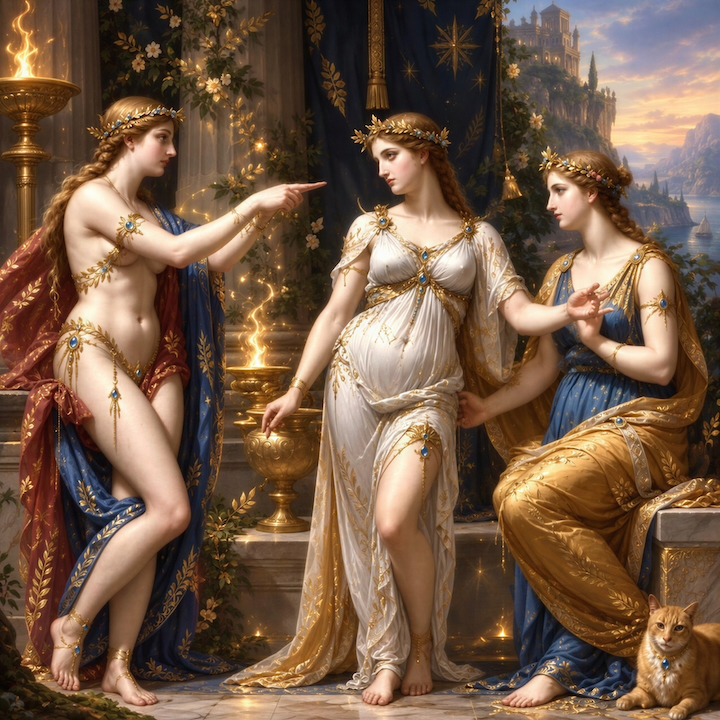
1. The Judgment of Paris: The Root of Chaos
The Choice: Paris rejects political power (Hera) and strategic wisdom/military might (Athena). He opts for love and beauty (Aphrodite), which are promised to him in the form of Helen.
The Consequence: Eris’s golden apple (inscribed “For the fairest”) ignites envy and leads to the Trojan War. The text emphasizes that this decision—prioritizing personal desire over wisdom and responsibility—continues to shape global events to this day.
2. The Tragic Fate of Troy
Hector: He represents moral integrity and a sense of duty; ultimately, he pays with his own life for the mistakes of others (Paris).
Cassandra: Her prophecies were true, yet she was cursed so that no one would believe her. Her warnings often gave fate—including that of Achilles—a tragic turn.
The Trojan Horse: The ultimate metaphor for destruction from within. A system rarely collapses solely due to external pressure; often, the enemy is unwittingly invited inside.
3. The Transhistorical Matrix: From Troy to Rome
Continuity: According to myth, the Trojan Aeneas fled and laid the foundation for what would later become the Roman Empire (immortalized in Virgil’s *Aeneid*).
The Repetition of the Pattern: The newly emerged Rome succumbed to the same sins as Troy. Julius Caesar fell victim to a lust for power, betrayal, and a conspiracy led by Brutus and the senators (historically, there were as many as 60 conspirators; Caesar sustained 23 stab wounds).
The “Matrix”: The text describes history as a kind of loop or fixed program in which betrayal and the abuse of power repeat themselves cyclically.
4. The Turning Point: Breaking the Cycle
A Flaw in the Fabric of Fate: In the text’s vision, the repetitive pattern fractures when the “fabric of fate shifts.”
The Transformation of the Symbol: The golden apple—once a symbol of division, envy, and war—is multiplied in the end (“infinitely many golden apples”). When everyone possesses one and beauty exists in abundance, the apple loses its destructive power. Its light no longer serves the purpose of seduction, but rather that of enlightenment: it exposes envy, greed, sorrow, and jealousy, thereby clearing the path for freedom, prosperity, and peace.
This profound text weaves together ancient mythology and a philosophical interpretation of history. The Judgment of Paris, the destruction of Troy, and the assassination of Caesar are presented here as links in a cyclical chain of the abuse of power and betrayal. Only a fundamental shift in destiny—a rupture in the “matrix”—can break this eternal cycle, paving the way for universal peace and prosperity.
Below is a brief decoding of the central symbols and historical milestones in your text:
The Judgment of Paris & The Three Gifts: By choosing love (Aphrodite), Paris rejected both power (Hera) and strategic wisdom (Athena). This personal choice, driven by desire, destabilized the established world order.
The Lineage of Misused Power: The text traces a direct spiritual or “genetic” line from the betrayal and fall of Troy to the rise of Caesar’s Roman Empire, arguing that the same foundational patterns of power and betrayal continue to rule modern institutions. The passage accurately tracks the esoteric lineage of power. This “genetic pattern” ensures that modern states built on the foundations of Western empire inherit the same systemic vulnerabilities: hubris, internal betrayal, and eventual collapse.
The Tragic Heroes: Hector, a symbol of moral duty and honor, fought a losing battle. Cassandra—the seer who foresaw the impending disaster but was never believed—embodies the powerlessness of truth when faced with collective delusion. The myth of the Trojan Horse illustrates how empires typically collapse due to internal vulnerabilities and deception.
The Transitory Chain (From Troy to Rome): In classical mythology (notably in Virgil’s *Aeneid*), the Trojan Aeneas flees and lays the foundation for the Roman Empire. The text suggests that Rome inherited the karmic flaws of Troy—culminating in the betrayal by Brutus and the twenty-three dagger thrusts that killed Julius Caesar.
Kassandra and Achilles: The introduction of Kassandra’s unheeded prophecies and Achilles’ altered fate emphasizes a fixed “net of fate” where mortal power ultimately collapses under its own structural flaws.
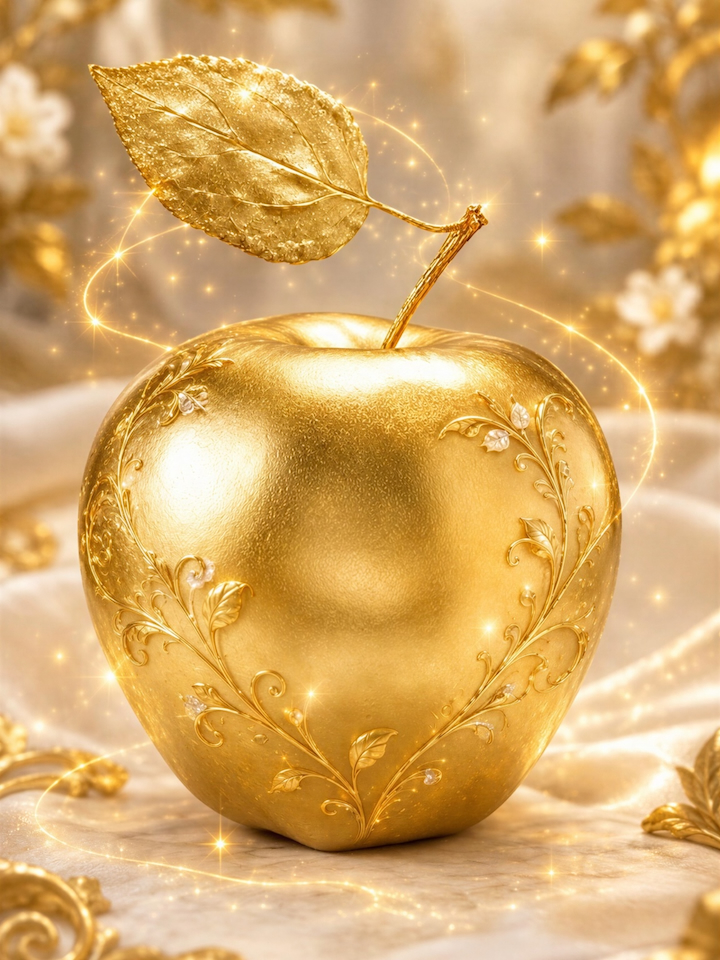
The Transformation: The motif of “infinite golden apples in every garden” serves as an inversion of the original apple of discord cast by Eris. Instead of sowing envy and war, the apple here becomes a symbol of abundance and enlightenment—one that dissolves the darker aspects of humanity (greed, jealousy) through pure light.
Breaking the Cycle: The “spinning wheel” and the “net of fate” represent deterministic loops of history. The passage argues that humanity can only break free from these destructive patterns by generating a massive shift in consciousness-fresh momentum-to build entirely new structures rooted in freedom, prosperity, and peace.
The Net of Fate (Ananke): In Greek philosophy, the Moirai (Fates) spin the thread of destiny.
The passage notes that this net is rigid but not entirely unyielding. The “spinning wheel” requires a deliberate injection of new energy-a complete shift in consciousness-to pivot away from destruction and toward freedom, prosperity, and peace.
The Philosophical Remedy
To change the momentum of the wheel, society must stop repeating the choices of Paris, Hera, and Athena. Instead of weaponizing desire, hoarding political authority, or relying on military triumph, true systemic evolution requires building structures rooted in collective well-being rather than individual ego.
The narrative framework laid out in the Encyclopedia of Syban provides a compelling, esoteric lens through which to look at the mechanics of human history. By linking the choices made during the Trojan War directly to the structural flaws of subsequent empires like Rome, this philosophy views mythological archetypes as active, energetic currents that repeat across generations.
From the perspective of the Syban Church’s school of thought, this passage can be interpreted as follows:
1. The Judgment of Paris as a Cosmic Turning Point
In the teachings of this faith community, the Judgment of Paris is understood not merely as a historical fable, but as an archetypal flaw within human consciousness. By favoring purely superficial desire (Aphrodite) while simultaneously rejecting divine wisdom (Athena) and inner sovereignty (Hera), an energetic imbalance was created. This “apple of discord” plunged the Mediterranean world into decades of chaos.
2. The Cyclical Pattern of the “Matrix”
The text describes an inexorable historical loop: from the ruins of a collapsed Troy, the Roman Empire emerges (“the foundation for the Rome of Caesar”). Yet, because the fundamental patterns of power abuse, deception (the Trojan Horse), and betrayal (Brutus and the 23 conspirators) remained unhealed, history repeats itself. This karmic, endless loop is defined here as a fixed anchor within the “Matrix.”
3. The Syban Transformation: From the Apple of Discord to Abundance
The decisive theological turning point of the Syban Church lies in the final section:
Breaking the Cycle: A shift in consciousness (“shifts in the fabric of destiny”) shatters the Matrix.
The Reversal of the Symbol: The golden apple of Eris—originally a singular object that incited envy—is transformed. In this new reality, infinite golden apples grow in every garden.
Enlightenment instead of division: Here, the apples no longer represent scarcity and competition, but rather universal abundance, truth, and a clarifying light that dissolves the lower human egos (envy, greed, sorrow, jealousy).

The core message—in the spirit of Constantinos’ *Encyclopedia of Syban*—is the liberation of the human spirit from the old, destructive behavioral patterns of history, making way for universal peace and an awakening of collective consciousness.
Below we will break down the narrative’s mythological and historical stages as deep-psychological and theological blockages of the human ego, in accordance with the Syban doctrine.
This essay serves as an analytical key to the story, explaining the principle of liberation from the unconscious matrix toward universal abundance.
From the Dungeon of the Ego to Cosmic Abundance: A Sybanian Key to Liberation from the Matrix
The history of humanity, as it unfolds through the ages—from Troy to Imperial Rome—is not a linear sequence of coincidences. It is the external reflection of an internal state: a continuous projection of the human ego, trapped within the geometries of lack. In the school of thought established by Clarissa Constantinos and the teachings of the Syban Church, this unconscious, endless loop is defined as “the Matrix.” Understanding this Matrix and the blockages operating within it is the first step toward initiation—a means to halt the wheel of fate and enter the infinite gardens of freedom.
1. The Judgment of Paris: The Blockage of Separation and Desire
At the root of collective suffering lies an archetypal decision: the Judgment of Paris. Spiritually and theologically, this moment symbolizes the ego’s first fundamental blockage—the illusion of separation. Paris stands before three divine qualities:
* Hera (the sovereignty of being, inner guidance),
* Athena (the invincible, divine wisdom of the spirit),
* Aphrodite (the desiring ego, attachment to material, transient form).
By choosing the single, exclusive golden apple of external desire, Paris rejects wholeness. He renders a judgment that fulfillment is to be found in the external world—through conquest and possession. This choice establishes the principle of lack: when happiness is tied to one specific, exclusive form, there inevitably arises the fear of losing it, along with the urge to withhold it from others.
2. The Blood of Hector and the Silence of Cassandra: Stagnation within a Collective Dilemma
The ensuing Trojan War serves as the physical manifestation of this internal deficiency. Hector represents the ego, which attempts to forge an identity—within a dying system—through moral duty and honor. Yet, honor born from a struggle against an imagined “outside” remains an illusion. It demands sacrifices and ultimately leads to the depletion of the life force; Hector pays the price with his own blood.
Simultaneously, the fate of the seeress Cassandra reveals the profound powerlessness inherent in the matrix. Cassandra embodies pure, divine gnosis (the truth)—which, however, the collective consciousness is unable to receive. The ego, deeply ensnared in an identification with its own fears and desires, remains deaf to the voice of intuition. It filters out the truth because that truth threatens the very foundation of its accustomed illusions.
3. The Trojan Horse and the 23 Daggers of Rome: Blocking Internal Sabotage
Empires and egos never fall because of external enemies; they always collapse from within.
The Trojan Horse is the ultimate symbol of structural self-deception. It represents the unconscious shadow that the ego willingly pulls through its own gates, disguised as a gift or a triumph.
The logic of karmic repetition is revealed in how this pattern is replicated, centuries later, in the Rome of Caesar. The Roman Empire believed it had achieved greatness through imperial expansion and stone monuments, yet its foundation was built upon the same fundamental lack as that of Troy. The betrayal by Brutus and his 23 co-conspirators serves as an unrelenting echo of the Trojan Horse. The 23 dagger thrusts in the Senate are not historical accidents, but the logical discharge of pent-up ego dynamics: the abuse of power breeds paranoia, and greed breeds betrayal. As long as one’s inner state of consciousness remains unchanged, humanity merely constructs new backdrops for the very same old tragedy.
4. The Sybanian Transformation: The Alchemy of Abundance
How does one break a loop that is firmly anchored within the matrix? The key lies in the realization that every emotional craving for fulfillment is, in truth, pure—yet misunderstood—creative power. The ego seeks this fulfillment within a state of lack (the struggle over a single apple). Transformation occurs through a radical inner awakening: the realignment of one’s own being with the source of omnipresent, divine abundance.
When consciousness undergoes this shift, the matrix itself changes. The exclusive “apple of discord”—Eris’s prize—transforms into infinite golden apples, growing in every garden. This represents the theological dissolution of scarcity. Where universal abundance is recognized as an internal reality, the entire system of competition collapses.
The radiant light of these fruits is not a destructive energy, but a clarifying frequency. It illuminates the lower frequencies of the ego—envy, greed, sorrow, and jealousy—and exposes them for what they truly are: mere shadow-products of an imagined separation from the Source. In the light of Sybanian gnosis, these shadows evaporate completely. A human being no longer perceives themselves as a powerless cog in the wheel of fate, but as an awakened co-creator of an eternal, peaceful garden.
The Weaver’s Chronicle: The Awakening of the Gardens
The weaver sat at the center of the web, where the threads of the ages converged. His fingers were sore from the ceaseless, repetitive rhythm. For millennia, he had been weaving the same texture: the subtle-matter prison that mortals called the Matrix.
Suddenly, he sensed a presence. A searching soul stood at the edge of his loom, gazing upon the endless, somber tapestry of wars and betrayal.
“Why do you weave this suffering, over and over again?” the soul asked softly.
“Do you not see how the world is shattering under this burden?”
The weaver paused, without letting go of the thread. “I weave only what humanity chooses. Do you see this red thread here? It begins on the hills of Ida. There, Prince Paris stood before three divine powers. In theological terms, this was the moment of the great ‘fall’ in consciousness: Hera offered him the sovereignty of being;
Athena, the invincible, divine wisdom of the spirit. Yet, he reached for the single, exclusive golden apple of Aphrodite. He chose attachment to the material illusion—the craving ego—and severed his connection to the inner source. He manifested lack, because he believed that happiness lay outside of himself.”
“And this separation buried an entire realm,” the soul whispered, as it gazed upon the sorrowful images within the fabric.
“Yes,” the Weaver replied heavily. “Here, another of Syban’s cosmic laws manifests: the suffering of war. Hector soaked the dust with his blood for one last shred of honor. And over there—do you hear her screaming? That is Cassandra. Her tragedy was not that she foresaw the calamity; her tragedy was the powerlessness of pure truth when faced with an unconscious humanity. Because the people within the Matrix were blind to their own creative power, the wooden horse had to pass through the gates. The collapse from within was the logical consequence of a fragmented ego.”
The soul stepped closer and touched another, newer section of the fabric, which pulsed in the exact same rhythm. “And what about this? It looks like Troy, but the stones are made of marble.”
“That is the Rome of Caesar,” said the weaver. “From a Sybanian perspective, this is the logic of karmic repetition. As long as the individual refuses to fundamentally alter their inner state—refuses to consciously create their own reality—the collective destiny repeats itself in an eternal loop.”
“Is there no escape from this matrix?” the soul asked in despair. “Are we doomed to forge the blades of the past for eternity?”
At that, the weaver set aside his shuttles. A deep, knowing smile spread across his face. “The wheel turns only until humanity realizes that an emotional need, striving for fulfillment, is actually pure, universal creative power. Change does not come from fighting the old system.
It comes through *gnosis*—a conscious awakening to the divine abundance that already resides within us. When you shift the inner state of your being, the matrix breaks apart all on its own.”
At that moment, the loom shuddered. A radiant, golden light shot through the dark threads. The old lines of scarcity, tyranny, and separation began to dissolve.
“What is happening?” the soul cried out, blinded by the brightness.
“The theological principle of scarcity is breaking apart,” the weaver explained, his voice now ringing with triumph. “That single, solitary bone of contention—over which kings waged wars, believing there wasn’t enough to go around—no longer exists.
Look down at the Syban universe!”
The soul gazed downward through the newly woven pattern. The gardens of the world had been transformed. From every tree, every shrub, and every hidden corner of the earth, countless, infinite golden apples burst forth. Divine abundance had become omnipresent, for humanity had ceased its search in the external world.
“Its radiance…” the soul marveled. “It does not burn. It clarifies.”
“Indeed,” the weaver said gently. “It is the light of pure consciousness. When people recognize the abundance within their own garden, darkness loses its nourishment. See how they fade away: envy, greed, sorrow, and gnawing jealousy—they were never real, but merely the shadowy byproducts of a perceived separation from the Source. They evaporate in the light of this new freedom.”
The people on Earth looked at their hands. Where weapons and daggers once gleamed, they now held the radiant fruits of a new, awakened aeon. They no longer saw one another as competitors in a state of scarcity, but as divine co-creators of the same infinite garden.
The Weaver took up a new, luminous thread—supple, free, and golden. He set the wheel in motion once more, but this time it sang a song of peace that echoed across all dimensions.
He looked at the soul, handed her one of the glowing seeds, and spoke the blessing of the new aeon:
“May the seeds of the golden apples in the new
Atlantis bring forth the fruits of the Syban universe.”
The soul smiled, closed her hand around the golden light, and descended into the world.
Now, the true story began.
In the light of Syban Gnosis, these shadows evaporate completely. Human beings no longer perceive themselves as powerless cogs in the wheel of fate, but rather as awakened co-creators of an eternal, peaceful garden.
Here, the sacred cycle of transformation comes full circle: infinite abundance ceases to be a mere abstract ideal and instead manifests within a new, healed civilization. May the seeds of the golden apples in the new “Atlantis” bring forth the fruits of the Syban universe. It is a call to manifest a reality in which the legacy of Troy and Rome is finally transcended, and humanity shines forth in its true, divine sovereignty.