
-Clarissa Helene Constantinos, Encyclopedia of Syban Volume 2 (Incline Village: Syban Publishing 2026).
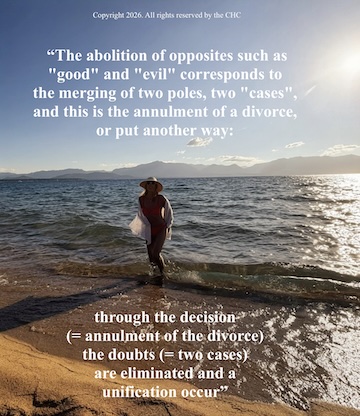
Core meaning: The quote addresses the abolition of binary dualism-specifically the moral construct of”good” and “evil”-framing it not as a battle where one side wins, but as a synthesis where the two poles dissolve into one unified reality.
Transcending Duality
The quote outlines a radical philosophical shift from a fragmented, binary worldview into unified, sovereign awareness.
The Illusion of Poles: Human perception naturally splits reality into stark opposites like
“light” and “dark.” The quote asserts that these are not separate entities but opposite ends of a single continuum.
The “Divorce” of Reality: The “divorce” refers to the psychological and spiritual separation humans create when they judge the universe through a binary lens. This separation generates doubt, conflict, and internal fragmentation.
The Illusion of Two “Cases”: In the philosophy of the Syban Church, concepts like good and evil are treated as temporary polarities rather than absolute truths. These opposites act like a “divorce” splitting a singular reality into two warring factions.
Traditional morality splits the human experience into strict binaries like ‘good’ and ‘evil’. The quote treats these not as cosmic realities, but as fragmented doubts that split human consciousness.
The Decision of Annulment: True illumination requires a conscious “decision” to look past these superficial dualities. By erasing the artificial divide, the individual reunites the polarized elements of their mind.
The Unification:
When the two poles merge,
“doubts” are eradicated. The consciousness achieves a state of pure, non-judgmental presence, collapsing the external illusion into a singular, integrated truth.
The Annulment of the Divorce: The quote suggests that true spiritual maturity or “the decision” removes the artificial split. By dissolving the boundary between the two poles, the illusion of separation is erased.The Metapher ‘divorce represents the psychological and spiritual separation of the self into warring faction.
The Act of Unification: By executing a conscious internal decision, the individual annuls this divorce. This step outside of binary judgment and collapses both poles back into a singular, unified state of awareness.
Elimination of ‘two Cases’ the Death of Doubt: When the human mind breaks out of binary judgment, existential doubts disappear. The individual steps into a unified state of consciousness that is devoid of judgment. When reality is fractured into opposites, it creates what the text calls ‘two cases’ or ‘poles’. Having two distinct cases forces the mind into a perpetual state of comparison, choice and doubt.
As long as “good” and “evil” are treated as two separate entities, the mind is paralyzed by the friction between them.
The “decision” mentioned is the sudden, transcendental realization that these two poles are actually part of the same continuum. Once you stop viewing them as separate, the “two cases” vanish, taking the doubt along with them.
The Abolition of Opposites
The ultimate goal of this philosophy is unification.
By collapsing extreme dualities-like good vs. evil, light vs. dark, or self vs. other-you reach a state of non-duality.
It suggests that absolute truths do not exist in the fighting factions of opposites, but in the single, unified field that contains both.
Clarissa’s perspective shares strong thematic ties with mystical theology and non-dual philosophy (such as Advaita Vedanta, Taoism, or Jungian shadow integration), where spiritual maturity is defined by moving past binary thinking to experience total oneness.