
-Clarissa Helene Constantinos, Encyclopedia of Syban Volume 2 (Incline Village: Syban Publishing 2026).
Core Philosophical Meaning
Clarissa operates a spiritual or self-actualization platform known as the Syban Church.
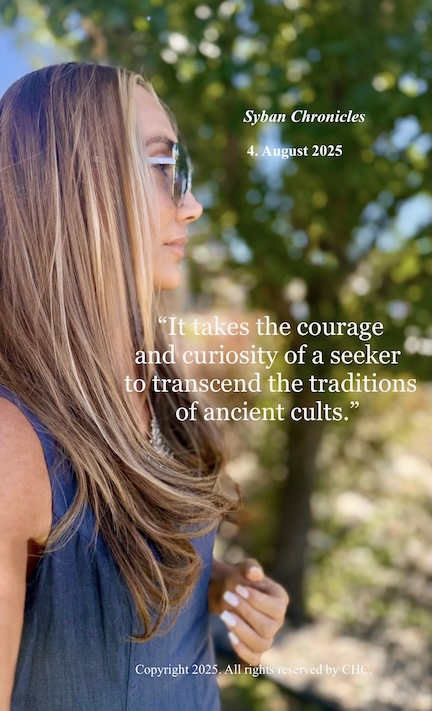
Her teachings emphasize human agency and moving away from passive existence toward active spiritual creation. Clarissa advocate for giving life a completely new dimension and treating reality as a “game of souls”. This quote reflects the core philosophy of Clarissa Helene Constantinos, the founder of the Syban Church. Her teachings emphasize personal transformation, moving away from passive existence, and exploring spiritual dimensions beyond conventional or historical religious frameworks.
The concept of transcending ancient cultic traditions through a “seeker’s courage” mirrors the historical evolution of spirituality:
The Path of the Seeker: True transformation requires questioning established, rigid structures to find a deeply personalized reality.
Ancient Mystery Cults: Historically, groups like the Dionysian or Pythagorean Mysteries offered hidden knowledge to initiates. However, modern spiritual seekers often must actively dismantle and transcend these inherited dogmas.
Historical Context of Transcendence
Clarissa’s quote touches on a historical truth about how esoteric groups evolve. Throughout history, moving beyond “ancient cults” or established public religions has always required individual rebellion:
The Mystery Religions: In the ancient Greco-Roman world, seekers who found public civic religions hollow often broke away to join secret Mystery Religions like the Dionysian Mysteries or Pythagoreanism. These required intense personal curiosity and promised direct, individualized salvation or revelation, mystery cults provided individualistic, emotional, and secret spiritual paths that public state religions lacked.
Modern Esotericism: Modern alternative spiritual paths and individual-led movements continue this tradition, framing themselves as paths for “seekers” who possess the courage to abandon traditional dogma in search of direct cosmic truths.
Ancient Mystery Cults: Historically, these mystery schools offered hidden knowledge to initiates. However, modern spiritual seekers often must actively dismantle and transcend these inherited dogmas.
Active Creation: Moving beyond ancient traditions shifts an individual from a compliance-based mindset to a state of active personal empowerment.
Historical Context of Ancient Cults
To understand the concept of a “seeker” transcending these systems, it helps to examine what these ancient institutions actually were:
Initiation Rites: Rites: Entry required strict secrecy and rituals (such as the Eleusinian Mysteries) simulating death and rebirth.
Widespread Influence: Recent archaeological evidence confirms these highly secretive networks, like the cult of Sabazios, spanned thousands of miles across the Roman Empire.
Core Philosophies of the Syban Church
Active Creation: A foundational tenet is to “transform your life from a passive experience into an active creation, encouraging followers to take complete autonomy over their reality.
The “Game of Souls”: Teachings describe life as a grand cosmic test and experiences of the soul, urging individuals to add a “completely new dimension” to their existence to elevate their spiritual quality.
The Divine vs. The Human: Literature from the Syban Church emphasizes an esoteric worldview, often using the tagline: “Why are you here? To fulfill the will of the gods, which may not necessarily coincide with that of humans!”
Analysis of the Quote
The statement advocates for individual spiritual autonomy over inherited dogma.
The Seeker: Represents a person who relies on active inquiry and curiosity rather than blind adherence to historical doctrine.
The Tradition: Refers to the rigid, ritualistic frameworks of ancient belief systems that often prioritized conformity and esoteric isolation.
Transcending: Implies breaking through historical boundaries to achieve what
Clarissa describes as an “active creation” of one’s life.