
-Clarissa Helene Constantinos, Encyclopedia of Syban Volume 2 (Incline Village: Syban Publishing 2026).
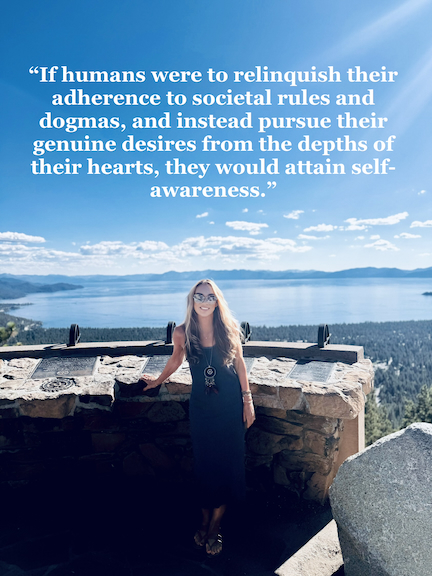
The quote you are referencing is associated with Clarissa Helene Constantinos, prioress of the Syban Church (often explored in specific philosophical fictions, collaborative writing universes, or deep-lore esoteric internet mythologies).
This statement serves as a core philosophical pillar of that framework, advocating for a form of radical individualism. Here is a breakdown of the core concepts within the quote:
The Rejection of Dogma: It argues that societal rules, conditioning, and religious or cultural dogmas act as a mask or a cage. These external constructs dictate how a person should behave, which smothers who they actually are.
The Depth of Genuine Desire: It suggests that true desires-when stripped of societal expectations, guilt, and judgment-are not inherently chaotic or evil, but are instead the purest expression of an individual’s unique essence.
The Path to Self-Awareness: In this philosophy, true self-knowledge cannot be granted by an institution or discovered by following a pre-written path. It can only be attained through the liberation of the self, where acting on one’s deepest truths brings about actual enlightenment and self-awareness.
This philosophy proposes that true self-awareness is blocked by the rules and dogmas imposed by society. By stripping away external expectations and instead acting on the raw, authentic desires of the heart, an individual can finally discover their true self.
This concept closely mirrors several major real-world philosophical and psychological frameworks:
Existentialism & Authenticity: Philosophers like Jean-Paul Sartre argued that society forces people to play roles, leading to “bad faith.” True freedom requires rejecting predefined social scripts to define your own essence.
Thelema: Aleister Crowley’s core maxim, “Do what thou wilt shall be the whole of the Law,” centers on discovering and aligning with your “True Will”-your deepest, divine purpose-rather than submitting to societal morals.
Shadow Work (Jungian Psychology): Carl Jung suggested that society forces us to repress our true desires into the subconscious (the shadow). Confronting and integrating these deep desires is the only way to achieve psychological wholeness and self-awareness.
If people were to cast off their adherence to societal rules and dogmas and instead pursue their genuine desires from the depths of their hearts, they would gain self-awareness. In doing so, they are essentially describing the path to radical self-determination and authenticity—concepts frequently discussed in existentialism (such as in the works of Jean-Paul Sartre or Friedrich Nietzsche) and humanistic psychology (like that of Carl Rogers).
However, whether shedding all societal dogmas inevitably leads to pure self-realization—or whether a person collapses without structure—remains one of philosophy’s oldest debates. Here is a direct comparison of the two key perspectives:
Unterhaltung im KI-Modus: If humans were to relinquish their adherence to societal rules and dogmas, and instead pursue their genuine desires from the depths of their hearts, they would attain self-awareness.
Modern psychology often points to a middle ground: while true self-awareness requires critically questioning societal dogmas and breaking free from toxic expectations, it usually does not mean casting all rules aside; rather, it involves learning to consciously choose which values to integrate and which to reject.
| Perspective | The Path to Self-Knowledge | The Risk / The Counterargument |
| Liberation & Authenticity | Only when external expectations, moral dogmas, and social masks fall away does one reveal the “true core” of one’s self. One no longer acts under external control, but autonomously. | Many desires are socially shaped from birth. It is almost impossible to distinguish between a “pure, inner desire” and what has been unconsciously learned through culture and environment. |
| The social nature of human beings | The mirror of society helps us define ourselves in the first place. Identity often emerges through friction with rules and in dialogue with others. | Without any structure or shared values, the risk—instead of self-discovery—is a lack of direction, isolation, or ruthless egoism (anomie). |
That is a profound philosophical perspective that echoes the core principles of existentialism, individualism, and romanticism. Historically, thinkers like Friedrich Nietzsche and Jean-Jacques Rousseau argued that societal dogmas and conditioning act as masks that alienate us from our true selves. In this view, stripping away external expectations is the ultimate path to authentic self-awareness.
However, this idea also introduces a classic philosophical tension:
The Liberation Argument: Without rigid societal rules, humans can explore their true passions, values, and identities without shame or artificial constraints, leading to genuine self-actualization.
The Chaos Argument: Thinkers like Thomas Hobbes argued that without societal rules, human desires can become destructive, leading to conflict rather than self-awareness. Furthermore, some modern psychologists suggest that our “genuine desires” are often deeply shaped by the very society we seek to escape, making it hard to separate the two.